
Tutoring Resources
Donald L. Potter
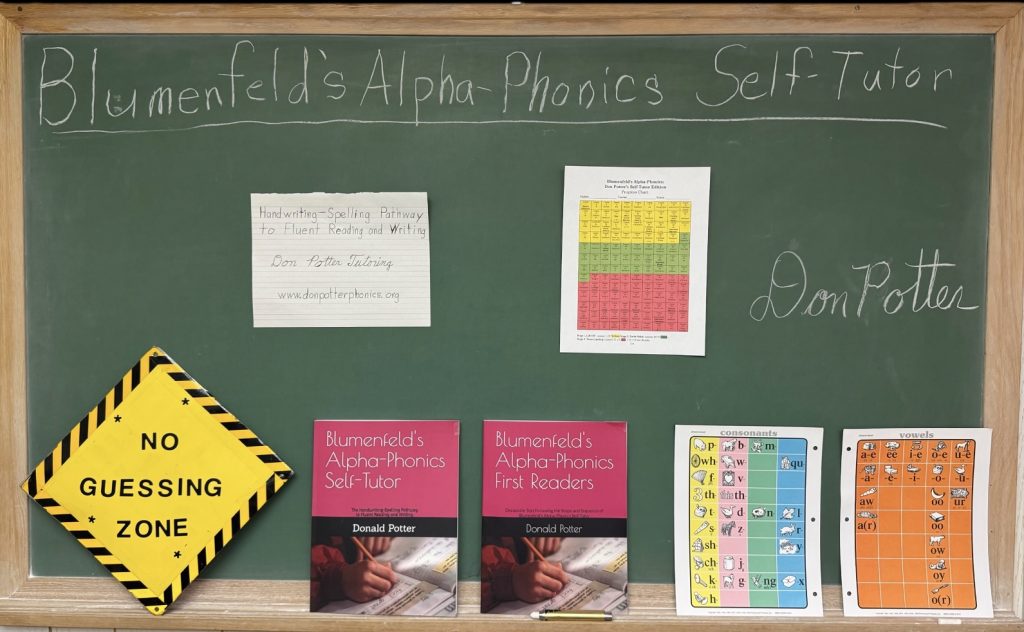
1. Blumenfeld’s Alpha-Phonics Self-Tutor: The Handwriting-Spelling Pathway to Fluent Reading and Writing. This link is to the new paperback available from Amazon or Barnes & Nobles. It is the flagship of my tutoring program.
2. Here are the free Audio Lessons for Blumenfeld´s Alpha-Phonics Self-Tutor. My students enjoy listening to the professional audio instruction to prepare to read and spell the words. They can also be assigned for homework. A chart is provided to record with tallymarks each time they listen to a lesson. Mature, motivated students can learn to read and spell on their own by following the audio instruction, which is why I call it a Self-Tutor.
3. Eleven Decks of Phonics Flashcards for building decoding fluency and flash recognition.
There is one set of flashcards for each of the 10 logical steps in the program. The cards are designed to provide the spaced repetition necessdary to develop an automatic phonics reflex and full orthographic mapping (sight-word recognition). Flashcards in Power Point.
4. Reader First Readers Anthology
This anthology contains 10 decodable readers and one book of poetry in a single volume, covering every spelling pattern in the English language – following the 10 Steps in the program. I believe they are the finest decodable readers available anywhere today at any price. First Readers in Power Point. Here is a Progress Chart.
5. First Reader’s Anthology. This is the 2026 manuscript handwriting paperback edition. The First Readers follows the Scope and Sequence of the Blumenfeld’s Alpha-Phonics Self-Tutor.
Feel free to visit my www.donpotterphonics.org which I pubished in 2026 to support the Self-Tutor.
Linguistic Introduction to 44 English Speech Sounds
1. Sound-to-Symbol Associations.
It is important to pronounce the phonemes (individual English speech sounds) correctly in order for the students to be able to apply them to decoding words. This video is a practical mini-course in English linguistics for teaching reading. Scientists would call the associations or relationships phoneme-grapheme correspondences.
2. Facial Diagrams for Phoneme Production.
These facial diagrams will be of great help to new teachers. They are designed to go with the training video above. Students also benefit from seeing how speech sound are formed in the mouth. A mirror is very helpful here.
These cards are based on the Spalding Phonograms adapted to the Alpha-Phonics Scope and Sequence. I have taught the program successfully with them and without them. Here is more information on the Phonograms.
Beyond Blumenfeld’s Alpha-Phonics Self-Tutor
1. Beyond Blumenfeld’s Alpha-Phonics Self-Tutor
I wrote this advanced level of reading instruction for students who have mastered Blumenfeld’s Alpha-Phonics Self-Tutor. Beyond Blumenfeld’s Alpha-Phonics Self-Tutor is generally appropriate for students beginning in third or fourth grade through college. The approach goes directly to the Anglo-Saxon, Romance (French and Latin,) and Greek Layers of the English language. It teaches the prefixes, suffixes, roots, and Greek combining forms in an easy-to-understand manner using expert audio instruction. The last section on English Homonyms is very helpful for vocabulary building and improving spelling.
2. Audio Instruction for Beyond Blumenfeld’s Alpha-Phonics Self-Tutor.
The audio instruction makes the program self-tutoring. The pronunciation and meaning of all the words are explained in detail.
3. Dr. Marcia K. Henry’s 1990 essay, “Organizing Decoding Instruction.”
Dr. Henry’s essay serves well as an introduction to my approach for improving student reading ability beyond fourth grade by teaching the Anglo-Saxon, Romance (Latin & French) and Greek layers of English.
Don Potter's Handwriting Videos
1. Zaner-Bloser Manuscript. This link will take you to a detailed and very practical explanation of the Zaner-Bloser manuscript handwriting method. Here is a link my Manuscript Handwriting Warmup, which I have found highly effective in developing the kind of fluent handwriting necessary to implement our handwriting-spelling pathway to fluent reading and writing.
This video is a detailed, step-by-step approach to teaching fluent (legible and fast) manuscript handwriting. The letters are taught in alphabetical order so the students gain equal proficiency with each letter. Here is the same method without midlines. This video follows Romalda’s Spalding’s original 1957 edition.
3. Cursive
This video provides detailed instruction on how to teach fluent cursive handwriting. My students won a national handwriting competition six years in a row. This method gets results and is easy to teach. I explain various letter forms so the program can be used to help prepare teachers to teach the different commercially available programs.
Recommended Commercial Handwriting and Spelling Programs
I highly recommend Zaner-Bloser Handwriting and Spelling-Connections. My experience teaching Dr. J. Richard Gentry’s Spelling Connections convinces me that it has no equal. Here is a Detailed Stroke Description for Zaner-Bloser Manuscript. Here are my Alphabet Tapping and Writing Exercises. The Spectrum series is also good for spelling, but Zaner-Bloser leads the field.
Questions for Educators:
1. Why are NONE of my new tutoring students able to write the alphabet fluently? (Is anybody teaching handwriting?)
2. Why can NONE of my new tutoring students pass the Gentry Grade-Level Spelling Test? (Is anyone teaching spelling?)
3. Why are ALL my new tutoring students being asked to memorize Fry Sight-Words? (Is anyone teaching phonics?)
4. Why can NONE of my new tutoring students use a dictionary to find a word, definite it, or pronounce it? (Does anybody care that kids are not being taught how to use the most powerful tool available for developing literacy?)
“RtI Blues” by Mr. Donald Potter
The Science of Reading
Videos from the Reading League.
1. Learning to Reading Words: Is it a Visual Memory Task?
2. Orthographic Mapping: What it is and Why it is important
3. Syllable Patterns and Syllable Division
4. Phoneme vs. Phonological Awareness: Knowing the Difference Matters for Assessment and Instruction.
5. Recent Advances in Understanding Reading Development and Difficulties: Prevention & Intervention.
6. Oral Reading Fluency: Understanding it to Improve it.
7. Strategies for Teaching Irregular “Tricky” Words.
8. Dispelling Misconceptions of Dyslexia. I do agree that some dyslexia is inherited, but I highly suspect that much of what passes for dyslexia is simply the logical result of inappropriate beginning reading instruction. Dr. Murry gives hope for improvement if appropriate instruction is afforded. I have taught people as old as 41 to read so I agree that it is never too late.
9. The Science of Reading a white paper by Laura Steward, Author and National Director for The Reading League.
10. Lyn Stone Orthographic Mapping Explained.
11. Popular animated presentation of Dr. Kilpatrick’s Orthographic Mapping. Reverse Sentence Reading
12. The Reading Wars: Phonemes or Whole-Words? A easy-to-understand YouTube presentation, 6:13 minutes.
13. Dyslexia and the Importance of Teaching Foundation Skills by Dr. Richard Gentry, whose Zaner-Bloser Spelling Connections is the epitome of a sound, science based spelling program that would greatly improve students’ reading and writing. This article was based partly on my correspondence with Dr. Gentry.
14. Tipping the Scale on Fountas & Pinnell. A short post on the downside of Guided Reading and Leveled Literacy Intervention. The same writer very up-to-date, informative article on “Research-Back Reading Instruction.”
15. 5 Practical Assessment Tips for Tutoring Struggling Readers. This is Psychology Today article (8/3/2021) by Dr. J. Richard
Gentry on how I test students to find out their real needs in order to provide optimal remediation.
16. Creating Dyslexia: It’s as Easy as Pie by Samuel L. Blumenfeld. This late scholar goes the heart of the problem.
17. The Essential Linnea Ehri. “A Research-Based Explanation of How Children Learn to Read” by David Parker.
18. Creating Better Readers and Writers: The Importance of Direct, Systematic Spelling and Handwriting Instruction in Improving Academic Performance by Richard Gentry, PhD., and Steve Graham, Ed.D represents the best current research.
19. Dr. David Kilpatrick. 1. How We Remember Words, and Why Some Kids Don’t. 2. Understanding the Role of Phonemic Proficiency in Boosting Reading Skills. 3. FAST (Phonological Awareness Screening Test) Test. 4. Facilitator’s Guide to to Essentials of Assessment, Preventing and Overcoming Reading Difficulties .
20. Dr. Mark Seidenberg: 1: Phonemes, Speech & Reading. 2. Becoming Phonemic. 3. Reading Learning and Instruction.
21. Reading and Spelling Skills. Slides by Linnea Ehri.
22. The Science of Reading, Winter 2020 by SCORE, State Collaborative on Reforming Education
23. Right to Read Inquiry & Teacher Librarian Journey to Structured Literacy. This is a story of one teacher’s journey from Reading Recovery & Balanced Literacy to Structured Literacy.
24. 10 Reasons Why RtI Doesn’t Work by Faith Borkowsky. RtI Blues: by Don Potter
25. Orthographic Mapping: How Do We Learn New Words (Sept. 2021) LaTondra Robinson, Bethani Welch. Mississippi Department of Education. Training slides. Very helpful.
26. Alabama Department of Education Infographic on The Science of Reading for Parents.
27. Balanced Literacy vs Science of Reading: What’s BEHIND this Debate?
28. Colorado Dept . of Education: Training by David Kilpatrick. This is the general access version, which is available for free but not credit.
29. Mark S. Seidenberg: “Where Does the “Science of Reading” Go From Here? A presentation at the Yale Child Study Center 12/4/23. Sketchy outline, but complete summary. Here is the voiceover of the lecture.
My Goal in an Aphorism
My goal is to present a program
with the simplicity the teachers desire
and the effectiveness the kids deserve.”
Mr. Potter’s Approach to Education
To teach the heart,
Where lies the gold,
My goal shall always be,
With warm love and true kindness
For all the world to see.
By Donald L. Potter 1/1/2014

© Don Potter.net Wide Interest Website 2026