Education Page
This page is dedicated to the dissemination of materials of value to parents and educators interested in improving the quality of education in America and throughout the English speaking world. I hope to include many PDF files of valuable books from the past. I will include select links to web sites and articles that I judge as being particularly valuable.
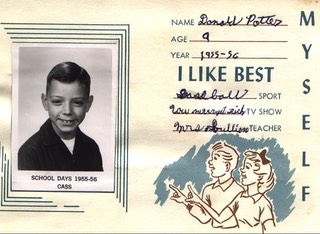
Below is my third grade picture. The lady on the right is my first grade teacher, Mrs. Monroe. She taught my dad for seven years in a one room school house. He skipped the 5th grade. She taught me in first grade and second. When I went to school there were two classes in each room. Mrs. Monroe taught me phonics, which explains why I have always loved to read. She read us wonderful books like Bears of Blue River and Uncle Tom Andy Bill by Charles Majors. She taught me to write cursive in first grade which is all I ever used until I became a teacher. Everyday in her class was fun, as her former students can all testify. She passed away in the middle of my second grade year. Her students continue to call her blessed for she blessed our lives with gift of the love of learning. My uncle Albert Potter taught me in seventh grade and was the principal of our little country school. Seven Laws of Teaching.
![]()
Click here for my You Tube Videos: DonLPotter I highly recommend Bruce Price's education clips.
DOWNLOAD HISTORIC ARTICLES by Samuel Blumenfeld
"Can Dyslexia Be Artificially Induced in School? Yes, Says Researcher Edward Miller." In March of 1992, Dr. Samuel Blumenfeld published a breakthrough article on whole-word dyslexia featuring the work of Mr. Edward Miller, the author of The Sight Word Eliminator and the Miller Word Identification Assessment (MWIA). Here is the same article in Spanish. Here is my YouTube clip explaining the MWIA. In 1993 Mr. Blumenfeld wrote "Further Investigation" regarding Mr. Miller's later research.
Professor William C. McMahon, of Danbury State College spoke on this very issue back in 1965: The McHahon Syndrome.
Here is another thought provoking article by Dr. Blumenfeld: Miscue Analysis: Training Normal Children to Read Like Defective Children. Here the scanned original: "Miscue Analysis For more information on "Miscue Analysis" read:Critique of Muscue 'Analysis by Hempenstall.
Twenty Years After Rudolf Flesch: Are the New Basal Reading Programs Doing the Job. (1975)
Here is a article Dr. Blumenfeld sent me (6/06/05): How to Cure Dyslexia.
You can read more of Sam's insights from this file: The New Illiterates - Quotes.
In March 2009, Mr. Blumenfeld sent me his eye-opening 1988 article, Dyslexia: The Disease You Get in School.
Purchase Blumenfeld's Alpha-Phonics (2005) from Chalcedon Ross House Books, P. O. 158, Vallecito, CA 95251-9989. Price $25.00 plus shipping and handling. 209-736-4365, ext. 12. By email: chorders@goldrush.com. www.chalcedonstore.com. Or just click on the title above.
Here is an important speech Mr. Blumenfeld delivered at the 1974 Reading Reform Foundation convention: Why America Still has a Reading Problem. And 1975 Letter Precision.
Here is a recent article (2008) Sam sent me "Why Pictures in Reading Instruction Are Harmful." Also read this research project on Pictures. Here is J. Samuel's, Jean Spiroff and Harry Singer's 1974 article "Effects of Pictures and Contextual Conditions on Learning to Read."
"How Should We Teach our Children to Write? Cursive First, Print Later!
Dr. Blumenfeld's insight is basic: "When you impose an ideographic teaching technique on an alphabetic writing system you get a reading disability. By eliminating the sense of sound from the reading process, one is breaking the crucial link between alphabetically written words and its spoken equivalent. Also, using sound symbols as ideographic symbols, one creates symbolic confusion." I like to say, "Using a sight-associational method to teach a sound-associational system creates associational confusion."
Here are some speeches by Dr. Blumenfeld: Why Teaching Phonics is Essential for Christian Education. Phonics vs. Look-Say.
Here is an article by Dr. Blumenfeld's good friend, Watson Washburn, "The Disintegration of Our School System."
Here is a little chart comparing Real Phonics and Phony Phonics.
MAJOR PUBLISHING EVENT
I am proud to publish a major new work by Mr. Harry Hattyar, Illiteracy in America: Understanding and Resolving a Grave National Problem. This comprehensive work is thoroughly researched and entirely up to date. On 3/5/07, Mr Hattyar send me a pdf document of his Easy Steps to Reading for free download. A major feature of this new work is the plethora of decodable stories. For those who prefer the convenience of a spiral bound printed edition, you can purchase it from Amazon: Easy Steps to Reading. Another book by Harry: The Primal Code
Download Free Phonics Programs (Programs from Don Potter)
FREE DOWNLOAD: Word Mastery: A Course in Phonics for the First Three Grades by Florence Akin, published in 1913. Here is perhaps the finest phonics program ever published. I retyped it (12/20/04) in large type on a standard 8 1/2" x 11" page, perfect for making transparencies. Be sure and read my "Note" at the end of the book. Here is an alphabetical list of all the words in the book: Word Analysis. This phonogram method is especially good for self-teaching because it relies more on simple phonics patterns than complicated phonics rules. Gene Roth of Arizona recently sent me Akin's earlier 1908 phonics book, A First Book in Phonics: Pages 1-12, 12-24, 25-35. It is a cute little book, but not nearly as comprehensive as Word Mastery. GoogleBook has made available a good copy of Word Mastery. You can compare my typed edition with this scanned edition. The print in my book is much larger. Cheryl Lowe of Memoria Press has recently published a nice paperback revision that I am happy to recommend: Classical Phonics.
FREE DOWNLOAD: Reading Made Easy with Blend Phonics for First Grade (1980) by Hazel Loring. Here is the easiest method for teaching beginning reading that I have seen anywhere. This little booklet will show any first grade teacher how to teach all children to read in four short months. It is also good for remedial reading instruction for any age. You can download a Blend Phonics' Certificate of Completion. Here is my Blend Phonics Reader. Here is an exhaustive analysis of the words taught in Blend Phonics: Word Analysis. For a stirring recommendation of Loring's method, see the article by Robert Sweet Jr.: The Century of Miseducation of American Teachers. Charlie Richardson has written a helpful supplement to Blend Phonics (or any other synthetic phonics program), for teachers who need a brief but informative introduction to phonics, entitled: The Alphabetic Code & How It Works. For audio-instruction on the "Alphabet Code," click here: Alphabet Code - mp3. In 1982, Hazel Loring won the prestigious Watson Washburn Memorial Award for Excellence in Education. Mrs. Loring wrote an excellent biographical article in The Reading Informer, a publication of the Reading Reform Foundation in 1979: "Intensive phonics the only way to go." Loring wrote, "All of my teaching experience has confirmed my belief that directional guidance, inherent in the blend phonics system, is the key to success in teaching reading." One of the primary goals of this web site is to provide every kindergarten and first-grade teacher with a copy of Loring's Blend Phonics. I have recently started a web page for Blend Phonics Campaign. I have also launched awww.blendphonics.org web site. Here is a YouTube Blend Phonics Video Clip.
FREE DOWNLOAD: 1824 American Spelling Book by Noah Webster. This is my "Easy-to-Read, No-Frills" edition (2/3/07). Of all the powerful phonics-first methods offered on this web site, this method remains the finest ever published. It is equally good for beginning or advanced readers - from kindergarten through college. I personally use my edition for advanced phonics. It is power is something to behold! Here is an edition that I produced that will be acceptable in public school classrooms: Webster for Modern Public Schools. Here is my third edition of the 1824 American Spelling Book with the jpg pictures deleted. This allows the book to be downloaded much faster, but has all of Webster's original expository material: Webster Without Pictures. Here is a special uppercase edition of Webster that will help cure lowercase configurational guessing habits.I am preparing flashcards to accompany this program: Webster Spelling Book Flashcards. Here is a Quicktime movie of the Webster's Syllabary, I did the audio and Elizabeth Brown developed it into a neat Qucktime move. For an in-depth study of old Spelling Books click on: Spelling Book Reference Page
FREE DOWNLOAD: How to Teach Phonics, 1916 supplemental phonics book by Lyda Williams. I found this book in a used bookstore in Lubbock, Texas. I think you will be as impressed as I was with the excellence of this phonics book. Note how it begins with lessons on phonemic awareness - in 1916! Very few of the modern reading programs can begin to compare with this little gem. Project Gutenburg has just republished my scanned copy of Williams' book, 7/29/06.
FREE DOWNLOAD: Through The Phonics Barrier: Student Manual by Dr. Charles Child Walcutt. Dr. Walcutt's method uses an older and very powerful phonogram method of teaching reading. For the full program and audio files for those who wish to teach themselves to read better, click on Through the Phonics Barrier Reference Page. Here is a Comparative Study of the Lippincott Basic Reading 1963-1981. Here is more information on Basic Reading. Here is a comprehensive study of the Basic Reading Vocabulary. Here is a comprehensive study of the phonics elements and vocabulary in the 1963 Basic Reading.
FREE DOWNLOAD: Remedial Reading Drills (1936) by Hegge-Kirk-Kirk. Rudolf Flesch used these phonics drills when he cured Johnny of his sight-vocabulary induced guessing habit. I have retyped the entire book in large, easy-to-read font and added some helpful instructional notes from Samuel A. Kirk's (1940) Teaching Reading to the Slow-Learning Child. Now you can see for yourself exactly how Flesch helped his Johnny. Today (3/30/07) I got an e-mail from Academic Therapy Publications announcing that they have just published a two volume edition with reproducible pages www.AcademicTherapy.com. I am delighted to see that this excellent method is available in an updated format. Teachers will welcome the reproducible pages: Phonics Reading Lessons: Skills and Practice.
FREE DOWNLOAD: Essential Phonics by Mona McNee. This is an excellent phonics-first program for the youngest to the oldest students. From a dear friend in England. Mona also publishes a larger synthetic program with games, Step by Step. Added 4/6/09.
A Course in Phonics by Corinne H. Johnstone (1912)
Free Online Reading Programs (Links to other sites)
1. Mrs. Elizabeth Brown has just published an excellent, interactive, online reading program for students from second-grade through adult. Very sophisticated phonics to support extraordinary high levels of literacy. All you need is pencil and paper and the newest edition of QuickTime. Click here: The Phonics Page. Here are some supplements I have created to facilitate the use of these lessons: Phonics Lessons Progress Chart, a Certificate of Successful Completion and Phonics Lessons Roman Reader. Here is an assessment Mrs. Brown developed to go with her program: The New Elizabethian, and The New Elizabethian - Uppercase. Phonics Lessons: Suggested Schedule. Phonics Lessons Association Ladder, a scope & sequence of the program.
2. Here is a simple online children's phonics (www.starfall.com) course that is interactive and lots of fun. LEARN TO READ
3. Stairway to Reading: by the Society for Quality Education (SQE) of Ontario, Canada is one of the best reading programs I have seen. It is very complete. The decodable sentences are great. While specifically designed for older children with reading problems, it can be used effectively to teach beginning reading..
4. How to be a Reading Tutor by Brad Hill: Reading Tutor. This phonics program has free phonics cards of words and sentences. Note: This link no longer works (1/8/09), but the program can be purchased at Reading Tutor.
5. Dr. D. W. Cummings, an eminent researcher into the science of spelling, has made his years of fruitful investigations into the English spelling system - and how best to teach it - available on his web site: D. W. Cummings - Spelling.
6. Phondots is a relative new way to teach reading that looks promising to me because it teaches from the sounds: www.phondots.com. I just started using Phondots with some of my tutoring students. The preliminary results are very promising.
7. Cat Phonics by Mona McNee is a step-by-step synthetic phonics program. Also see her Myths of Reading Mona has just published a new book (2007), The Great Reading Disaster
This book is a bombshell that is destined to cause a cosmic shift in the teaching of beginning reading instruction in the English speaking world. Here is a real gem of wisdom from Mona: "Guessing is a terrible thing. It is not a 'strategy' for reading. It is a a danger signal tell us that the pupil cannot read from the letters. The only 'Don't' in my lessons is 'Don't guess.'" Mona has just published her complete course in an instructional video format: www.phonics4free.org.
8. The Sounds of English web site by Dr. Norbert Rennert of the Summer Institute of Linguistics in British Columbia. This unique Online program gives educators or students access to the patterns of the English language in a systematic and controlled manner for any stage of the reading or writing progress.
9. Web-Cam Tutoring: North State University (North Dakota) Reading Clinic sponsor very inexpensive Online tutoring with intensive phonics to help students from 1st through 12th to read better. Dr. Timothy Houge is the Clinic Director. You may contact Dr. Houge at houget@northern.edu or by phone: 605-626-3169.
10. I purchased The Candy4Way Phonics Program July 4, 2010. It costs less than $10.00 and is a very good intensive phonics program.
11. Reading Key. Not exactly free, but there is a lot of excellent information on teaching reading on this site.
Recent Brain Research on Reading: Geraldine Rodgers
New Essay by noted reading researcher, Geraldine Rodgers: The Born-Yesterday World of the Reading "Experts:" A Critique on Recent Research on Reading and the Brain. (also Born Yesterday WP2). It gives me great pleasure to invite all visitors to my web site to read this recent and thorough critique of leading brain based research projects. To see my attempt to draw and explain the "Reading Triangle" mentioned in the this paper, click: Beginning Reading. On Sept. 5, 2005, I produced a Power Point presentation of the Reading Triangle which will help you visualize how it works. It is a big file - 20 meg. The concept of using a triangle to illustrate the two paths to reading was published by Henry Suzzallo in 1913: Beginning Reading. Miss Rodgers cuts right to the heart of the reading problem in this article: "WHY NOAH WEBSTER'S WAY WAS THE RIGHT WAY." Here is the 1912 article by Myrtle Sholty that mentions the two types of readers: A study of the reading vocabulary of children. Also note Josephine Horton Bowen's 1911 article, Learning to Read. Charlie Richardson's article Reading: Phonics vs Whole-Language is largely based on Miss Rodger's theory. Mr. Richardson wrote a letter to Dr. Sally E. Shaywitz in 2003 discussing points of contact between her brain research and his theory of acquired dyslexia: The Dyslexia Debate: Nature, Nurture or Both?
RESEARCH PROPOSAL: Have you ever wondered how students today would compare with students one-hundred years ago? On June 22, 1983 in New York City, Geraldine Rodgers presented a paper at the National Institute of Education Competitive Hearings on Proposed Research Projects. Her proposal was titled "To Urge the Repetition of the Ayres' Spelling Test of 1914-1915 to Confirm the Existence of Massive Present-day Reading Disability and to Establish its Cause and Cure." Ayres' book and Miss Rodgers' proposal are published here in hopes that researchers will seriously consider the implementing the proposal and the important information it would provide for policy-makers today. Here is a copy of Leonard P. Ayres' book A Measuring Scale for Ability in Spelling. Here is the Chart that was included as a foldout in the back of the book or as a separate sales item: Ayres' Chart. Charlie M. Richardson shows us how the Ayres Scale can be used as A Ready Made Literacy Scale. Here is Geraldine Rodgers' Introduction to Ayres. Here is link to a very nice scanned edition of Ayres Spelling Scale. Here is Ayres' Memorial at the Arlington National Cemetery. For those who care to know more about Ayres' statistical work, here is his The War With Germany: A Statistical Analysis.
Anyone interested in the true facts about history of reading should be sure to read The History of Beginning Reading by Miss Geraldine Rodgers. The Amazon bound copies are a bit expensive, you can purchase the searchable e-book version at The History of Beginning Reading E-Book for a mere $8.95.The Hidden Story
: How America's Present-day Reading Disabilities Grew Out of the Underhanded Meddling of America's First Experimental Psychologist. You can read my quotes from the book by clicking The Hidden Story - Choice Quotes. And here is my YouTube clip: Hidden Story. For a brief, but insightful introduction to the two fundamental approaches to reading, "sound" vs "meaning," read this two part article by respected researcher Charles M. Richardson: Reading His personal web is: The Literacy Council. For an early critique of the sigh-reading method, read Samuel T. Orton's famous 1929 article,The "Sight Reading" Method of Teaching Reading, as a Source of Reading Disability.
1977-1978 Oral Reading Research. Miss Rodgers compares the results of teaching the popular sight-word beginning reading programs with phonics-first programs in her book recently published book (2006): Why Jacques, Johann and Jan CAN Read. Research was conducted in several languages. The results lead to her insight into the two kinds of readers. This is fundamental, groundbreaking research. Order Your copy at: Why Jacques, Johann and Jan CAN Read
1981, 1982, 1983 Indictment against silent reading tests and their devious negative influence on reading ability in America: Case for the Prosecution
View my YouTube videos, where I read all of Chapter 2: "Why Would Anyone in Their Right Mind Want to Teach Sight Words, Anyway? In 1986 Miss Rodgers sent testimony to the OVERSIGHT ON ILLITERACY IN THE UNITED STATES Hearing before the House of Representatives. You can read her testimony here: "Phonics First."
The Spelling Doctor: Raymond Laurita
One of the major influences on my understanding of the teaching of reading is the work of Mr. Raymond Laurita. He rightly calls himself The Spelling Doctor. He is the creator of Orthographic Structuralism, a new and exciting scientific way of looking at written English. His web site was closed in December 2007. Ray has given me permission to publish his articles on this web site. The article "Spelling as a Categorical Act" serves well an introduction to his foundational book, Orthographic Structuralism: The New Spelling.
1. A Critical Examination of the Psychology of the Whole Word Method
2. Basic Sight Vocabulary: A Help Or A Hindrance
3. Frustration and Reading Problems
4. Spelling as a Categorical Act
5. A Plea to Restore Reading as a Spoken Activity
6. Vertical Word Processing: A New Approach For Teaching Written Language to The Learning Disabled Adolescent. Phillip W. Trembley. MA.
7. Reversals: a response to frustrations?
8. Understanding the Significance of the Individual Letters of the Alphabet in the Development of Full Literacy. Here is a much faster-to-download, easier-to-read edition of this invaluable document: Understanding the Significance of the Individual Letters of the Alphabet in the Development of Full Literacy.
9. Rehearsal: A Technique for Improving Reading Comprehension. (Teaching Teenagers)
10. Errors Children Make. This 1967 article is the essence of wide experience and sound judgment.
12. Spelling Problems Resulting from the Delition of the Second Consonant in Root Forms.
11. Here are two more essays: Spelling Progress Bulletin 1971
13. Cessation of Spelling Newsletter. On June 21, 2006, Mr. Laurita ceased publication of his popular Spelling Newsletter.
14. Does Holding a Child Back Help or Hinder (The Crisis, Aug & Sep 1966).
Essays from Dr. Pat Groff
1. Myths of Reading Instruction - and why they persist.
2. Sight-Words the Humpty Dumpty of Reading Instruction.
3. The New Anti-Phonics is the Same Old Look Say.
4. The Rise and Fall of "Whole Language" and Return to Phonics.
5. Review of Lucy M Calkin's The Art of Teaching Reading
6. Whole Language: Emancipatory Pedagogy or Socialist Nonsense?
Misreading Analysis: Helen Lowe
Gives Insight into Faulty Word Identification Strategies and Informs Effective RemediationIn 2002, I began to carefully record student's misreadings of words in order to gain insights into their word identification strategies so that I could design effective remediation instruction. I was influenced to do to this by three masters in the field who had done similar work, Raymond Laurita, Diane McGuinness, and Helen Lowe. Helen Lowe wrote two articles of particular value, one in Atlantic Monthly (1959), and a longer article in Charles Walcutt's book of essays, Tomorrow's Illiterates (1961). Here is her insightful Atlantic Monthly article: Solomon or Salami. I recently found the entire article on the Phonics Institute web site: Phonics Institute. Geraldine Rodgers recently sent me an earlier article published by Lowe entitled How They Read. Here is the more extensive article written forTomorrow's Illiterates: The Whole-Word and Word-Guessing Fallacy. Here is a speech she delivered in 1963 "Update to How They Read.". Here is a link to Helen Lowe's granddaughters web site: Granddaughter Link. Here is a 1954 essay that includes an interview with Mrs. Lowe: "Why Don't They Teach Them to Read." Here is a research summary from 2001: How Psychological Science Informs the Teaching of Reading. Here is a briefer summary by the same authors: How Should Reading be Taught. The Usefulness of Brief Instruction in Reading Comprehension Strategies. This is a somewhat skeptical view of "comprehension instruction."
Rudolf Flesch (Phonics-First)
Why Johnny Can't Read and what you (parent) can do about it.
No book has shaped my thinking about reading instruction more than Rudolf Flesch's 1955 best seller, Why Johnny Can't Read and what you can do about it
. The book remains a model of solid research and clear thinking. The best part of Flesch's book are the 72 highly effective phonics exercises at the end of the book. Here is a whole page of materials I have developed for teaching his method:Rudolf Flesch Instruction Page.
Mr. Edward Miller's Test for Artificially Induced Whole-Word Dyslexia
The Miller Word Identification Assessments (MWIA)
To determine if a student has whole-word dyslexia, give him or her the the Miller Word Identification Assessment (MWIA I or II). This assessment tool consists of two lists of carefully chosen words, a Holistic (sight-words) List and a Phonics List. If the student reads the Phonics List slower and/or misreads more phonics words than the Holistic List, they have whole-word dyslexia and need immediate remediation. I am making the test available as of 9/27/03 here is the MWIA I Test and Instructions. I hope that many parents and teachers will print the pdf file of the test and give it to their students. Here is a sample test: MWIA I Sample Test and Sample Summary. The MWIA I & II are available as of 7/22/03: MWIA I & I Test, Manual & Summary Sheet. I usually give the MWIA II. Click here for an MWIA II Analysis I prepared for one student: Student Word Processing Strategies Analysis. I consider the MWIA the poor man's fMRI. Mr. Miller also has a Sight Word Eliminator (SWE) that can help students with artificially induced whole-word dyslexia. To view my a small SWE that I made, click here: Great Stone Face SWE I. Here is an Explanatory Introduction to the SWE based on Mr. Miller's original SWE. Don Potter's 'Notes on Ed Miller's Complaint to the FTC concerning Dr. Seuss' sight-word books. Here is Mr. MIller and Rick Dixon's 2004 Update to the Complaint to the FTC. Here is my edition of The Great Stone Face in uppercase letters to help students to overcome configuration reading by eliminating configuration.You can purchase Mr. Miller's test and Sight Word Eliminator. Note: My edition of Mr. Miller's test is from Charlie Richardson. It has 420 words. Charlie Richardson was a great advocate reading and the MWIA in particular. He passed away on March 13, 2008. Here is an "In Memory of Charlie Richardson" by Robert Sweet. Here is Mr. Miller's patent for making a Sight Word Eliminator. Mr. Miller passed away in June 2009. Here is a link to Mr. Richardson's article, Whole-Language Causes Dyslexia.
Sam Blumenfeld's Alpha-Phonics
I would certainly be amiss to fail to mention the one book that I have used to teach more students to read than all the others combined: Blumenfeld's Alpha-Phonics (2005 revised & expanded edition) by Dr. Samuel Blumenfeld. I taught Sam's comprehensive, easy-to-teach reading program for seven years in the public school classrooms and in private tutoring. You can still order the original 1983 edition at: Alpha-Phonics. Here is a Comparison of the two editions: Alpha-Phonics Comparison. The New Illiterates ranks with Rudolf Flesch'sWhy Johnny Can't Read, and Charles Walcutt's Reading: chaos and cure as one of the great exposes of the sight-word fiasco. In the school year 1999-2000, I taught Alpha-Phonics to a second grade bilingual class. Teachers interested in teaching Alpha-Phonics to large classes of students in a single school year should find my detailed lesson plans of great value. You can find them at Potter's Daily Lesson Plans for Teaching Alpha-Phonics. Here is a jpg file of the Certificate I gave the students: Alpha-Phonics Certificate. You can download a set of Orton Phonograms that I developed to assist me in teach Alpha-Phonics to a large class. Here are materials for teaching Total Alphabetic Recall. I have prepared two audio instruction files for the Alpha-Phonics Phonograms: (1) a Long Version and (2) a Short Version. Perhaps others would like to read my Word Analysis of 1983 Alpha-Phonics, which I produced to satisfy my own curiosity. Here is a Word Analysis of the 2005 Blumenfeld's Alpha-Phonics. I have also written an analysis of Sam's Blumenfeld Oral Reading Test (BORAT). Here is a new Alpha-Phonics Cursive & Reading Progress Chart. The new version of Blumenfeld's Alpha-Phonics has just been published. If you would like to purchase a copy, please send a check for $29.95 plus $3.50 shipping and handling (total: $33.45) to Sam Blumenfeld, 73 Bishops Forest Drive, Waltham, MA 02452. Here is an article Sam wrote in Sept. 1994 on Cursive First. Paul Lukawski's Intensive Phonics (Alpha-Phonics) Testimonial. Here is my progress chart for Mr. Blumenfeld's First Readers. Here is my Cursive Road to Reading and Spelling Sentences Progress Chart. Here are the Cursive Road to Reading and Spelling Review Sentences. Cursive Road to Reading and Spelling Phonogram Cards. Here are some YouTube Testimonials: Dr. Obadiah Williams & His 22 Years Teaching Alpha-Phonics. Lauren Baxter mother of six learn with Alpha-Phonics. For teachers in a situation where they are, unfortunately, required to teach print-first, here is a copy of the Printing Road to Reading and Spelling Practice Sentences. Mr. Blumenfeld published an effective home phonics primer in his 1973 The New Illiterates: Preschool Primer.
Dolores Hiskes' Phonics Pathways
I have found Phonics Pathways by Dolores Hiskes of particular value in helping children with whole-word dyslexia. It is equally good for beginning readers or remediation. Order you copy at: Phonics Pathways. Dolores has a new supplement to go with Phonics Pathways called Phonics Boosters that I highly recommend. Dolores has a third book that is great for developing fluency. It is aptly called Reading Pathways
It focuses on strengthening the eyes, increasing eye span, and improving blending and syllabication. I highly recommend that everyone read her recent essay on why students are having comprehension problems (It may not be what you think!): Comprehension: extracting vs. construction meaning. Here is a very important presentation Dolores gave at the International Reading Association Phonics Special Interest Group this year (2008) Comprehension.
Becoming A Nation of Readers
Here is a link to the famous government document Becoming a Nation of Readers.
YAK Phonics
YAK Phonics by Dr. E. M. Swengel, Ph.D. was on an old Reading Reform Foundation Book List. You can learn more about it at YAK Phonics. You can also purchased his novel Plainston Chronicles from Amazon. More information on Dr. Swendel's work at the Institute for Mutual Instruction.
Webster Blue-Backed Speller
In the history of reading in America, no book has had as profound an impact as Noah Webster's Blue-Backed Speller. Rudolf Flesch in his justly famous book, Why Johnny Can't Read, and What You Can Do About It, wrote of Webster's Speller, "The Blue-Backed Speller was a fourteen-cent medicine that cured you of illiteracy. Nobody dreamed of criticizing it as wrong, unscientific or ineffective." Miss Geraldine Rodgers explains the advantages of Webster's Spelling Book for teaching beginning reading in her brilliant essay: "WHY NOAH WEBSTER'S WAY WAS THE RIGHT WAY." Miss Rodgers' comments refer to the pre-1828 editions. I am presently publishing a "No Frills, Easy-to-Read" edition of the 1824 American Spelling Book, which I consider his best. Except for the personal and place names, the entire book is completed. I made final additions and numerous corrections on 3/01/07. Here is my mp3 audio for for Webster's Analysis of Sounds. And here is the Webster's KEY the vowel sounds and his Syllabary: Vowel Key and Syllabary. Here is a Quicktime movie of the Webster's Syllabary, I did the audio and Elizabeth Brown developed it into a neat Qucktime move. In the interest of getting Webster's method back into public schools, I have produced a "secularized" version which retains all of Webster's awesome phonetic method, but deletes the reading sections, which however full of Biblical wisdom, would be unable to make it past the public school censors, Webster for modern public schools.
FREE DOWNLOAD: I have scanned Webster's 1908 (1829, 1857, 1866, 1880) Blue-Backed Speller for you to download to use in your teaching: Webster 1 - 20, Webster 21 - 40, Webster 41 - 60, Webster 61 - 80, Webster 81 - 100, Webster 101 - 120, Webster 121 - 140, Webster 141 - 160, Webster 161 - 174 Essay by Laurie Bluedorn: How to Use Webster's Speller.
School Phonics
Unique, unusual, fast, fantastic, delightful, colorful, fun, scientifically based, and exciting are all words that describe School Phonics published by Didax Educational Resources. The authors, William C. Carroll, and Kenneth A. Lexier, are experienced hands at publishing reading methods for children. It will teach first-graders practically everything in phonics by midterm, like its predecessor the original Open Court. It covers the same phonics skills as the Blue Book (long vowels) and the Gold Book (short vowels) of the Foundational Program in the original (pre-SRA) Open Court. I suggest visitors to my site consider the program for adoption in public, private, and home schools: School Phonics. Here is excellent article by Jann Flury on the program: Happy Chaps at School. Here is my detailed Analysis of the 1985 Open Court Headway Program. Interesting book review by Diane Ravitch concerning a recent book about the old Open Court: "The Triumph of Look-Say" Here is an article by Arther Trace Jr. delevered at a NRF meeting in 1963 and a review of Open Court when it first came out. Here is a satire by Dr. Trace: Roger Joikl's Revenge. Here is a highly suggestive study of the advantages of teaching Long-Vowels-First. Here is Al Henderson's 1987 article on the old Open Court: Reading by Ear. School Phonics is based on the Association Method of Mildred McGinnis. Here is a monogram on the Association Method. Here is a School Phonics Student Progress Chart.
3RsPlus - Dick Schutz
3RsPlus web site: BRI and ARI Phonics Readers. The Readers are available in English at Piper Books. This site has several in-depth articles on the development, history, and architecture of the method. For an Online interactive version see Reading Ware. Brian D. Marriott has made the first series available for free download: I See Sam. It is cheaper to purchase the books, but you can review them here.
I See SamArticle by Dick Schutz: The Non-Impact of Reading First—Where to Go From Here
Structural Reading by Catherine Stern
I am delighted to discover that Catherine Stern's K-2 Structural Reading program is still available. This is an excellent program for for teaching very young children. Stern recommended teaching blend phonics (successive phonics/cumulative phonics) before starting word-families so the students would establish good left to right scanning. I believe she was correct in this recommendation.
Direct Instruction
Siegfried Engelmann, Phyllis Haddox, and Elaine Bruner
Teach Your Child to Read in 100 Easy Lessons. Just click on the title to order the book. I have found this method especially effective with students who have a difficult time learning to read with other methods. It is very detailed and EASY to follow. I have even used it to teach second grade bilingual students to read English with understanding. Here are some movie clips from the Association for Direct Instruction. Here is Phillis Haddox's website for Teach Your Child. Here is an interactive course on Englemann's DI. Here is the Zigsite, where you can learn all about Siegfried Engelmann - his life and theory.
MyStudyHall.Com
"As a supplement to classroom instruction, MyStudyHall.com offers children and parents an alternative to traditional tutoring and study centers. English/Language Arts/ Reading units for upper-elementary students through teens offer understandable step-by-step instructions and then quiz students to let them see for themselves how well they have mastered the material." This is a must web site for students who want to improve their English Language Arts skills. They have twenty-day free trial. I use it as an advanced program for my phonics reading students. Here is a recommendation you can share with others on the Internet: MyStudyHall. Here is a Progress Chart I prepared for the Grammar Modules.
New Ultra-Simple Phonics-First Program
Isabel L. Beck has recently published a practical introduction to phonics that ranks with Florence Akin, Rudolf Flesch, and Hazel Loring for practicability: Making Sense of Phonics
. She clearly works her way through the theory of reading and ends the book with a phonics method that is the ultimate in simplicity and effectiveness.
Phonics for Home Methodology
Here is a very complete YouTube Video that teaches an enormous amount of excellent phonics: Phonics for Home Methodology.
What Price Desegregation?
A thought provoking article from the Feb.-Mar., 1987 Reading Informer. It is by Mary S. Jackson. What Price Desegregation? Along with Jackson's article, be sure and read Dr. Patrick Groff's Whole Language: Emancipatory Pedagogy or Socialist Nonsense?
Mary Johnson's Two Sentence Reading Test
Here is a very clever Two Sentence Reading Test you can give your students. I am adding articles by Mrs. Johnson at the end of this test. Mary Johnson was the author of Programmed Illiteracy in our Schools, (1971). Mary Johnson also wrote a phonics based ESL method which I plan to make avilable later this year. [GREAT NEWS: Marsha Palansky, Volunteer Services Coordinator of theInternational Centre of Winnipeg ssent me a complete set of Mary Johnson's ESL materials. I appreciate Marsha's help.] Read more about the results of giving this assessment: Oral Reading Survey, New York City, by Mary Johnson. Also read, Mary Johnson's One Woman War by Stephen Franklin.
Sidney Ledson's Method
Sidney Ledson's Teach Your Child to Read in Just Ten Minutes a Day
teaches two year old children to read with an excellent, easy-to-teach phonics-first method. Visit the Sidney Ledson Institute web site. This is an excellent method for very young children. He has a lot of excellent information on how his method prevents and cures dyslexia.
Edu-Steps by Pat Doran
I piloted this phonics program for older students when I taught junior high. The program was developed by professor Pat Doran of Gilbert, Arizona. Her program is called Phonics Steps to Reading Success. It is a fast-paced word attack system for developing and improving reading skills. Pat has over 30 years experience working with students with reading problems. The program teaches high-level decoding skills (over 5,500 words) using transparencies, making it possible to teach large groups of students in an effective and economical manner. I especially recommend her fascinating book, The Secret Club: Why and How We Must Teach Phonics and Essential Reading Skills to Under-performing Readers of All Ages. One junior high student improved four grade levels in only 11 hours tutoring with me.! The program usually takes between 20 to 30 hours to complete. Dramatic results have also been reported by other teachers using the program. It is appropriate for ages 10 to 100. Here is a short essay by Pat: Steps to Reading Success. The Teacher's Manual is included right on the transparancies!
TATRAS Direct Vertical Phonics
Every parent and reading teacher will want to carefully examine the TATRAS Direct Vertical Phonics Program by my mentor and good friend Mr. Frank Rogers. His TATRAS Phonogram Sequence Chart is a single piece of paper that contains the entire phonetic system of written English. TATRAS stands for Teaching America To Read And Spell. In April of 2003, one five year old boy demonstrated mastery of all 68 phonograms and 840 Core words. He scored independent third-grade on the 1987 Riverside Informal Reading Inventory. He had a perfect score on the MWIA I proving that he had absolutely no whole-word dyslexia! You will want to read the story I wrote for him: "How Johnny Learned to Read in Kindergarten." Here is the Progress Chart I made for my class:TATRAS PROGRESS CHART. Here is a certificate I give the students once they have mastered all the TATRAS Core Words:Student Teacher Certificate. Be sure and visit Mr. Rogers informative web site: Vertical Phonics. Johnny's teacher continues to use TATRAS.
National Right to Read Foundation
Since its founding in 1993, the National Right to Read Foundation has worked to fulfill its ambitious mission of returning comprehensive, scientifically-based reading instruction and good literature to every elementary school in America. For parents who are concerned about their children's reading ability, the NRRF has provided an excellent, easy to administer Reading Competency Test. To make it easier to print, I have republished it as a pdf file. Click here: Reading Competency Test. This test tests both code knowledge and grade-level. (For dyslexia, I recommend the Miller Word Identification Assessment.) The work of the NRRF was preceded by the Reading Reform Foundation, founded by Watson Washborn in 1961. Here is the "Summarization of the Afternoon Session, First Annual Conference, RRF, August 1, 1962. View Bob Sweet's 2007 International Dyslexia Association Power Point Presentation: "Research to Practice: Where Do We Go from Here?" Also visit the Reading Reform Foundation in the United Kingdom.
WE ALL CAN READ
Mr. James E. Williams has produced two outstanding phonics programs: one for K-2nd Grade, and another for 3rd-Adult. His use of nonsense word and sentences for older readers is especially to be commended. You can visit his web site at: WeALLCanRead.
Progressive Phonics
Ernest H. Christman has produced a very distinctive method for teaching reading with phonics-first in "five levels of phonics difficulty." One unique feature of his program is that he teaches the long and short vowels together in "Level One." Each level is accompanied by enjoyable decodable stories. The book can be used as an invaluable sequel to other phonics programs or as a stand alone program. I uses it as a follow-up to Alpha-Phonics to teach advanced phonics. It is the most complete review of advanced phonics rules that I have seen. Order your copy from Amazon: Rx For Reading: Teaching Them to Read with Phonics
Or directly from the the publishers (large print readers available): Tutorial Press
Spalding Progarms (Writing Road to Reading)
Myrna McCulloch of the Riggs Institute has an unusually rich mine of invaluable information available concerning beginning reading. Her articles are all worthy of careful study: Riggs Institute. Here is a paper delivered by Sylvia Franham-Diggory at the 1987 Reading Reform Foundation Conference: From Theory to Practice in Reading. Michael Brunner was a great advocate trainer for the Spalding Method. Here is some biographical information from a speech he gave at the 1985 Reading Reform Foundation Conference: Brunner's Speech. Here is Brunner's 1981 analysis of the Houghton Mifflin Reading Program: "Vowelectomy." Yes Phonics has made available a detailed explanation of their method of teaching Spalding. Wanda Saneri, a Spalding teacher, delivered the following excellent address: Literacy Today: What's Wrong and How We Can Fix It (2001). Michael Brunner, a great Spalding advocate and practitioner, wrote a very important research report entitled, Reduced Recidivism and Increased Employment Opportunity Through Research-Based Reading Instruction. It is well worth reading. Here is a YouTube video of the Spalding Phonograms. Here is the first of another video: Madsen Method.
Peterson Handwriting: Good handwriting and good reading go together, both should be automated in order to free up the mind for good comprehension and creative composition. The Peterson Handwriting Company has done some highly sophisticated research into process of automated handwriting. Visit their web site at: Peterson Handwriting. They have published a REVIEW COPY of their entire program at: Handwriting - The Complete Program. Here is a must-see video training session with Randy Nelson: How to. This is a MUST read. Matthew McNatt has written that, "Just as well-taught writing can help students' reading, poorly taught writing can hinder students' reading." Read his comments on the effectiveness of the Peterson Method at the McNatt Learning Center.
Here is Dr. Robert Rose's new book, Forget the Bell Curve. Mr. Rose maintains that early letter writing fluency is the key to early reading success. I have found a very closes correlation between alphabet writing fluency and reading ability in my tutoring students. Here are some materials I have developed for helping students develop fluent alphabet letter writing and identification ability. Don Potter's Alphabet Fluency Program.
Here is a link to the once famous Palmer Method (1915). I like this 1866 method by my namesake, S. A. Potter, Penmanship Explained. Sam Blumenfeld maintains that we should start children writing with Cursive First. just as everyone in America learned to write before 1923. I totally agree, especially since I was taught Cursive First when I began school in 1953. Here is a good link to some old handwriting methods: Nib. Here is the Zaner method of cursive handwriting and a lot of other school ideas from 1921: Zaner Penmanship. Public School Penmanship: A Handbook for Teachers. 1909. Manual of Free-hand Penmanship, 1877. How to Teach Writing, 1892. The Theory and Practice of Handwriting, 1897. This is a theoretical and practical book advocating vertical penmanship. Here is a very satisfactory handwriting method with complete details: Complete Manual of Commercial Penmanship, 1893. Teacher's guide for the Palmer Method. Here is the 1935 Palmer Method of Business Writing. The Palmer's Penmanship Budget (1919) is very complete. Perhaps the best introduction to Palmer is his Self-Instruction in Modern Writing; A Complete School of Penmanship at Home: Muscular Movement - Its Development and Application. Margaret M Hughes 1910 Graded Movement Writing for Beginners. Here is a Spanish translation of Mr. Rose's thesis. Graphics: A Manual of Drawing and Writing (1835). HAND-BOOK TO ACCOMPANY THE ECLECTIC SYSTEM OF PENMANSHIP (1870). I prefer cursive-first, but if you are required by your school to start with manuscript this YouTube clip will help: Manuscript Lesson. Here is a Handwriting Reference Book from ERIC. Here is another ERIC document: Communicating Through Handwriting: Handbook for Manuscript and Cursive Handwriting. Another Eric document: Research on Handwriting and Spelling. You can create Zaner-Bloser Cursive Handwriting sheets at ABFontsOnline. Jeanette Farmer shows how multi-sensory handwriting handwriting training is a safe alternative to Ritalin: Retrain the Brain. Graded Movement Writing for Beginners (1910) by Margaret M. Hughes. Muscular Movement Writing Manual (1921) by C. C. Lister - a superb work. Manual of Fundamentals for the Teaching of Handwriting in the Public Schools (1918) by Tom Sawyier. Graded Movement Exercises - very valuable and lots of fun for the kids. Children Who Write as Men Wrote Before Printing (1925) by Francis M. Moore - advocates a form of manuscript, but interesting. Here are the Zaner-Bloser letter strokes - very helpful. Here is another document explaining good Penmanship Basics. Here is information from 1925 concerning Majorie Wise's part in bringing manuscript to America. Here is a marvelous YouTube clip demonstrating how the Palmer letters are made. Psychology and Pedagogy of Writing by Mary E. Thompson (1911). Public School Penmanship: A Handbook for Teachers (1909) by Albert Willistine Clark is loaded with exercises. The Teaching of Handwriting (1914) by Frank N. Freeman. Freeman, also published as series of four articles on handwriting in the Elementary School Journal: A Course in Handwriting. His 1918 The Handwriting Movement: A Study of the Motor Factors of Excellence in Penmanship is a classic study. Complete Manual of Commercial Penmanship (1893) by Clarence E. Spayd. How to Teach Writing: A Manual of Penmanship Designed to Accompany Appleton's Standard Copy Books (1892) by Lyman D. Smith. Luthy's Scientific Handwriting being an Analysis of Roman Script Form and execution (1918). John Jenkins (1813) The Art of Handwriting. Ames' Guide to Self-Instruction in Practical and Artistic Penmanship (1884) by Daniel T. Ames. Far and away the BEST exercise book for cursive is The Champion Method of Practical Business Writing by Mary L Champion. Teachers using cursive exercises for curing ADHD will find this book most helpful. I use the drills every day in my classes. Palmer Guide to Business Writing (1894). The Psychology and Pedagogy of Handwriting (1920) D. E. Hamilton. Here is C. P. Zāner's justly famous The Arm Movement Method of Rapid Writing (1904). The Payson, Duton & Scribner Manual of Penmanship (1872). Penmanship: Determining the Achievement of Elementary School Graduates in Handwriting (1916). Walker Method of Writing for Public and Private Schools (1922): One of the most useful books on handwriting ever published. "Handwriting, Posture and the Use of Pencil Gripper" (1991) by Dennis Hoover. Kinesthetic Approach to Handwriting (1998) by Mary Benbow. Supervision and Teaching of Handwriting (1926) Joseph S. Taylor. Five Top Handwriting Problems and What to Do About Them (2008) by Laura Sena. English Handwriting 1500-1700. Penmanship Made Easy (1919) by Edward Summers Squier. M.A. A most delightful and helpful textbook. I See Sam Handwriting Resource, very some excellent information. Here is the 1918 New York City Penmanship Scale. Penmanship: Determining the Achievement of Elementary School Graduates in Handwriting (1916). A Handbook to Accompany the Eclectic System of Penmanship (1870). Here is an important recent article on the neurological advantages of handwriting over keyboarding. Here is an importance article on handwriting and literacy, Digitizing Literacy: Reflections on the Haptics of Writing by Anne Mangen and Jean-Luc Velay. For those who are unfortunate enough to have to teach manuscript to beginning students, here is a clear explanation of Romalda Spalding's Method. Pencil Grip: A Descriptive Model and Four Empirical Studies (2003) by Ann-Sofie Selin. Dr. Patrick Groff: Handwriting and its Relationship to Spelling. A convenient Summary of Zaner-Bloser Strokes. YouTube Clip for teaching left-handed students.
Writing to Read: Evidence for How Writing Can Improve Reading by Steven Graham and Michael Hebert.Typing
Typing skills should be taught systematically just like handwriting skills. One does not take the place of the other, but they mutually reinforce one another. I am of the opinion that students should not be asked to type until they have been taught how to type correctly. www.goodtype.com has very good free online typing program. www.powertyping.com also has a simple program. TypingWeb is also very good. Rational Typewriting (1917). Methods of Teaching Typewriting (1919), an excellent reference manual. The Psychology of Skill, with Special Reference to Its Acquisition in Typewriting (1908) by William Frederick Book. Touch Typing For All (1948) by John Comstock Evans. Almenaja Method for learning typing. Nimblefingers.com.
PHONOVISUAL METHOD
Since its publication in 1943, the Phonovisual Method has proven itself to be a highly effective method of teaching reading with phonics. I have been using the Charts in my tutoring work and have found them to be very useful when used in conjunction with Rudolf Flesch's 72 Phonics Exercises in his book Why Johnny Can't Read and what you can do about it (1955). My success promted me to investigate the historical background of the method and to analyze the linguistic organization of the Charts. Here are the results of my investigation: Phonovisual Reviews. Their web site is: www.phonovisual.com. Here is Caroline Yale's (1892, 1946) Formation and Development of Elementary English Sound containing the original Northampton Charts. Here is Alexander Graham Bell's 1906 The Mechanism of Speech. Here is an audio mp3 recording I made for students to practice the sound on the charts: Student Phonovisual Audio Instruction: Consonants. Student Phonovisual Audio: Vowels. Here is a 1965 Evaluation of the Phonovisual Method. More on Caroline Yale. Dr. Frank B. Withrow has some information on the Association Method. Here is Yumiko Nakamura's 2005 Master's Thesis on the phonovisual method for teaching spellings and sounds. Here is Schoolfield's 1944 Patent for an Educational Device. Dr. Frank B. Withrow gives us some insights into the Association Method.
Right Track Reading Lessons
I recently received a review copy of Mrs. Miscese R. Gagen's Right Track to Reading Lessons (2004). The program would be very easy to teach. It is quite complete, even teaching lots of prefixes and suffixes to help students decode multi-syllabic words. Her web site is loaded with excellent, original articles, worth multiple visits to her web site. At only $25.00 this is a real value. Mrs. Gagen's has just published a remedial course for older students (3/30/07) Back on the Right Track to Reading.
Phonics e-Seminars For Puzzled Parents and Frustrated Teachers
by Ann Ireland: On Top of the World Press
On Nov. 24, 2006, I stumbled upon a very inexpensive ($40.00) and complete phonics program by Ann Ireland: Phonics e-Seminars.
I heartily recommend the three following COMPUTER PROGRAMS
for helping student learn to read.
The first is by my good friend David Hickerson of 4:20 Communications. One third grade student recently completed Phonics Tutor Frequent Words in less than three weeks and increased her reading level by three grades! These programs are very complete presentations of the entire English Orthographic System. I might add that all their work evidences a thorough understanding of English Orthography and a solid grasp of good educational psychology. Here is their web site: Phonics Tutor. I have created a PTFW Student Progress Chart.
The second program is one I have found extremely valuable for all children. I have used it with students in all the elementary grades, bilingual, and English-only speaking. It is called Read Write and Type. It teaches phonemic awareness, touch typing, vocabulary, reading, and spelling all in one super fun program. It has special Spanish toggle that gives assistance in Spanish. The web site is: Read Write and Type Here is a review and evaluation from the Florida Center for Reading Research. To make Read, Write, and Type work on Windows XP, you will need to download a special Patch: Patch for RWT I also use their newest program Wordy Qwerty for advanced spelling and reading. Here are Student Progress Charts I have made for both Read Write and Type and Wordy Qwerty. Here is a Class Record Chart for RWT. Be sure an check out Jeannine Herron's Blog.
The third program is Ultimate Phonics Reading Program by Spencer Learning. Their "Resource" is particularly rich in free materials. This program uses the mouse and does not require any typing.
Advanced Decoding Skills: M. K. Henry's WORDS program
One program that sees heavy use in my teaching is the incomparable WORDS program by M. K. Henry. I say incomparable because this one program teaches, phonics, vocabulary building, reading, and spelling by instructing the students in the three levels of English orthography (spelling): Anglo-Saxon, Romance, and Greek. The author recommend the program for third grade and up, but I have have used it effectively with second-graders. Order your copy at: WORDS
She published a very valuable article concerning the organization and effectiveness of her program in a book published by the Orton Dyslexia Society entitled All Language and the Creation of Literacy (1991). I am pleased to announce that I have received permission from the International Dyslexia Association (www.interdys.org) to publish the article on my web site. You can read it by clicking on the title, Organizing Decoding Instruction. Her newest book Unlocking Literacy: Effective Decoding & Spelling Instruction
is a gold mine of information. Here are some handouts Mrs. Henry published 2009: "Organizing Phonics Instruction for Student Success." For a most revealing insight into the absolute necessity of systematic instruction in the three levels of English orthography, see the revealing charts by Don McCabe at: Reading by Grade Three. Say What?
Where to Start
A good place to begin research in reading is with Diane McGuninness' block buster book, Why Our Children Can't Read and What You can Do About It. The second chapter explains the four faulty reading strategies used by most students: 1. letter-name-decoding, 2. name-to-sound-translating,3. sight-word-reading, 4. and real-word-guessing. She observes, "Failure could come a early as first grade or as late as third, when the real-word guesser with the fabulous visual memory and terrific vocabulary finally breaks down. A child's poor reading strategy will not self-correct without appropriate remediation. ... Most of the time, a child's decoding strategy is invisible to the teacher and parent. In order to discover a child's reading strategy you need do listen to him read individual words and record each misread word phonetically." (26) Order this breakthrough publication at: Why Our Children Can't Read: McGuinness Her son Goffrey and daughter-in-law Camen created the , Reading Reflex
: The Foolproof Phono-Graphix™ Method for Teaching Your Child to Read. I have used and highly recommend this method. Dr. Diane McGuinness recently wrote a very thorough article on reading for the Reading Reform Foundation in Great Britain: A Prototype for Teaching the English Alphabet Code. Samuel Blumenfeld wrote a review of McGuinness' book: Review of McGuinness.
Just Read Florida
THE SOURCE: A Curriculum Guide for Reading Mentors. This is a 184 page, information-packed, comprehensive guide for reading mentors.
Cognitive Process in Education
Sylvia Farnham-Diggory, a modern master of the science of cognitive psychology, has written two very valuable books detailing the implications of recent developments in cognitive psychology for education. The first book, Schooling, is a popularization of the implications of recent advances in the scientific understanding of the human mind as an information processor. Her larger work,Cognitive Process in Education, details the history and implication of cognitive psychology for education. Schooling is in print and can be ordered at: Schooling. Her larger college textbook, which is out of print, can be ordered used at: Cognitive Process in Education. Here is her paper, From Theory to Practice in Reading, delivered at the 1987 Reading Reform Foundation Conference. Here is a paper she wrote in in 1976: How to Study Reading: An Information Processing Analysis. You can read the same article in a snippet view of Theory and Practice of Early Reading, Vol. 3, edited by Lauren B. Rensick and Phyllis A. Weaver, "How to Study Reading."
A Scientific Approach to Reading Instruction
Barbara Foorman, Jack Fletcher, and David Francis: Center for Academic and Reading Skills (CARS)1997: Scientific Approach
Charles A. Perfetti, one of the premier reading researchers, has published significant portions of his research at the following address: Perfetti
Joseph J. Torgesen, Essays from a leader in the field. See numerous other important essays and papers at The Florida Center for Reading Research.
Joyce Morrison's 1933 paper on Fonicsfobia. A study of the cause, prevalence, and cure of psychological fear of phonics instruction.
The Simple View of Reading by Wesley A. Hoover and Philip B. Gough. This is a VERY important paper. Automaticity and Decoding. Ronald P. Carver: Causes of High and Low Reading Achievement. Here are some quotes from Carver's book with some personal observation: Carver Quotes. Auditing and Reading (1974) by Thomas G. Stick, Lawrence J. Beck, and Robert N. Hauke essentially takes the "simple view of reading." Cynthia S. Puranik and Linda J. Lombardino use Carver's rauding theory as an "Assessment Paradigm."
A brief article by Maryanne Wolf, "New Research on an Old Problem: A Brief History of Fluency."
Advanced student of science of teaching reading will want to read closely Denis G. Pelli and Katharine A. Tillman's research article, Parts, Wholes, and Context in Reading: A Triple Dissociation.
National Reading Panel Report on Phonics. Raises almost as questions as it answers. The report is based on several programs that are no longer available or have not been updated to new state standards.
Fluency is a major issue in reading. Ronald Carver called it "rauding rate." Here is a very clear presentation of the issue: Fluency: Achieving True Mastery in the Learning Process.
"On The Functional Architecture of Language and Reading: Trade-Offs Between Biological Preparation and Cultural Engineering" by Thomas Carr. Something of a summary of modern evidence.
"Connectionist Model of Word Reading" by Mark S. Seidenberg. The following quote is a classic: "Some of these children may be ‘‘instructional dyslexics’’ who were taught using methods that did not incorporate phonics, which slows reading acquisition, as occurs in our models under similar training conditions."
"Knowing letter names and learning and learning letter sounds: A Causal Connection" by David L. Share. A recent provocative study. I have been on both sides of the letter name controversy, most recently on the side that views letter name knowledge as important.
The Classic Readabililty Studies by William H. DuBay. This is a source of the original readability studies with commentary by Mr. Dubay.
Links for Precision Teaching: Binder on Ceilings; Removing Ceilings, Everybody Needs Fluency, Binder, Behavioral Fluency. Ken Johnson's Encyclopedia Article. Very important article by Ken Johnson on the Morning Side Model of Generative Instruction.
Development of the Ability to Read Words: Update, Linnea Carlson Ehri.
To Read or Not to Read
This 2007 report by the National Endowment for the Arts is a real eye opener concerning the state of reading in America and what it means for the future of our Country: To Read or Not to Read.
Progress in Understanding Reading
by Keith StanovichFor the brave soul who is willing to tackle a mountain of information to gain a clear and unobscured view of what we know about effective reading instruction, I recommend Keith Stanovich's Progress in Understanding Reading. He began his research with a bias in favor of the so called psycholinguistic, top-down approach of Ken Goodman and Frank Smith. His research led him to very different view. You can purchase the book, and even read a few very interesting pages at: Progress in Understanding Reading. Click here for a link to his valuable essay, What Reading Does for the Mind. Here is another essay by Stanovich, one which has has made a lasting impression on reading research: Matthew Effects in Reading. Here is his essay: Romance and Reality. Quite a bit of Progress in Understanding Reading can be read from the Google limited preview. Ronald P. Carver wrote an extensive Review of Progress in Understanding Reading from the viewpoint of his rauding theory.
Whole Language Lives On: The Illusion of Balanced Literacy
by Louisa Cooks Moats
I am well aware of the popularity of Balanced Literacy in American education circles today. It is a supposed healthy balance between Phonics and Whole Language, as if the two somehow could be made to work together. Rather than comment here concerning my opinion in the matter, I will let Louisa Moats' devastating critique of Balanced Literacy speak for me. You can read her in-depth article at: Whole Language Lives On. Here is a very important paper criticizing whole-language from a linguistic view point: 40 Professors of Linguistics. For a well documented historical introduction of the phonics/whole-langauge controversy read this article by E. Jennifer Monaghan. Here is a recent paper by Dr. Moats that is well worth reading: Whole Language High Jinks: How to Tell When "Scientifically Based Reading Instruction" Isn't. Here is Sebastian Wren short article on "Reading and the Three Cueing Systems." Here is a 1891 Popular Science Magazine article "Unnatural Reading" that will demonstrate that the concept and practice of whole-language has been around before its modern day representatives were born, and got the same dismal results. Here is a very complete reading assessment by Christopher Wren: The Abecedarian Reading Assessment.
Bilingual Education
I would have to say that bilingual education is one of my greatest loves. My fifteen years as elementary bilingual educator were among the most wonderful in my life. I was fortunate to have been trained by three of the best mind in the field: Dr. Robert Medrano, Dr. George Gonzales, and Ms. Les Vela. They taught me the value of building a strong cognitive foundation in the native language, while quickly developing the student's oral and literary competencies in English. My Raleigh mountain bike is a familiar sight to all my former students who were used to seeing me ride up with a backpack full of Spanish and English books ready for them to read to me. Their parents always invited me in and offered me the their typical hospitality, which often included watermelon, burritos, tacos and a glass of water or ice tea. Bill Honig wrote a balanced and interesting article on bilingual education that you might enjoy reading: Dealing with Non-English Speaking Learners. For those who would like to know more about how I taught Dr. George Gonzalez "Total Integrated Language Approach," here are my notes from the workshops I attended.
Cognitive Psychology Meets Word Recognition
Here is an article on "Word Recognition" by Kevin Larson a Font Expert at Microsoft. If your are into cognitive psychology, you will have some real fun reading it: The Science of Word Recognition. Kevin writes, "The goal of this paper is to review the history of why psychologists moved from a word shape model of word recognition to a letter recognition model, and to help others to come to the same conclusion." To me, the implications for teaching phonics-first are obvious
Augustin G. Rudd: Bending the Twig
Anyone interested in the history of education and why there are so many illiterates coming out of our public schools should read Augustin G. Rudd's Bending the Twig: The Revolution in Education and Its Effect on our Children (The Heritage Foundation, Chicago, 1957." He sponsored scholarships for the Reading Reform Foundation.
Test your Phonics Knowledge: Practice Quiz on Phonics.
If you made it to the bottom of this long page, you deserve a little humor. Here is a funny, but sadly true article on whole-language:Thank You Whole Language.
Susan Jones has some excellent material at here website: Resource Room. Susan is the Academic Development Specialist at Parkland College, Campaign, IL.Here is an Online program that will let you do a Readability Analysis in several languages.
On-line Reading Lab: America - Today and Tomorrow
Here is one of the best finds this year: On-line Reading Lab. Here are excellent information articles with self-grading comprehension tests. This reading practice at its best. This is not phonics, but it is excellent reading practice. Thanks to Dr. John Paul Loucky's who sent me the link.
Here are Flash Cards for about everything under the sun!
English Lab Work by Dennis Doyle. It is for his English class, but the material is very useful.
Books Online
Miss Maggie's An Old Fashioned Education is loaded with great material for a great education for your child.
For great site for free book classics Online click on: bartelby.com
You hear great books read at LibriVox.
Old Children's books can be found at The Baldwin Project.
For over 90,000 books Online: Digital Book Index
University of Virginal Library: e-booksMaking of America (MoA) is a digital library of primary sources in American social history from the ante-bellum period through reconstruction. The collection is particularly strong in the subject areas of education, psychology, American history, sociology, religion, and science and technology. The collection currently contains approximately 9,500 books and 50,000 journal articles with 19th century imprints.
Phonics and Reading by Van Liew and Lugas (1897). This is something of an advanced reference book.
Practical Studies in Sentence Analysis by Howard L. Hunt, 1919.
S. G. Green's 1875 Grammar of the English Language.
Sheldon's Primary Language Lessons (1895). Excellent lessons for young children.
Here is Webster's "An Improved Grammar of the English Language, 1833, 1843.
Here is a Webster Dictionary from 1833.How to Write Clearly by Edwin Abbott, 1890. An excellent expositon of the principles of clear writing.
The Essentials of the English Sentence (1900) by Elias J. MacEwean. One of the clearest and most helpful grammars I have ever studied.
How to Parse. Another book by Edwin Abbott. A marvelous work.
English Lessons for English People by Edwin Abbott, 1901. This is a masterwork.
His Hints on Home Teaching will be most helpful to homeschool parents.
How to Tell the Parts of Speech: An Introduction to English Grammar. Another book by Edwin Abbott.
The Derived Spelling Book by John RowbothamPhonetic and Structural Generalizations for Teaching Primary Grade Spelling, by Wm. A. Kottmeyer, Ph.D. This is a useful summary of Kottmeyer's Ph.D. thesis. He was a very influential special education reading teacher. He advocated what he called "single letter phonics" as opposed to "spelling-family phonics." His method is essentially the same as Rudolf Flesch, Phonics Exercises, Hazel Loring's Blend Phonics, the Hegge-Kirk-Kirk Remedial Reading Drills, and Dolores Hiskes' Phonics Pathways.
Simplified Spelling, Phonetic Alphabets, and their application to the teaching of reading, by Betty Lou Allen Iles, M. S. (Ed.), 1965 Here is Part 2 This is a lot of hard-to-get information.
Here is information on Leonard Bloomfield's Let's Read. You can read the Preface and Instructions and some of the lessons by clicking on the title. Here is a Times essay on Let's Read. Here is an article on Dyslexia by an advocate of Bloomfield's spelling method of teaching reading. Wayne State University just sent me a review copy of the new edition. It is excellent.
Anyone with the fortitude to make it to the end of my long Education Page will find The Psychology of Mastering the Elements of Reading, by D. B. Elkonin a prize well waiting for.
GRAMMAR-LAND OR, GRAMMAR IN FUN FOR CHILDREN OF SCHOOLROOM-SHIRE (1878) by M. L. Nesbitt, A truly unique and enjoyable grammar for children.Guide to Grammar and Writing.
Here is Ernest Vincent Wright's novel, Gadsby: A Story 50,000 Words Without Using the Letter "E."
Word Count: This is an engine that will do syllable counts and other readability statistics.
Download: Can You Read Me Now? Learn how to use Readability Formulas