Spelling Book Method of Teaching Reading
Reference Page
by Donald L. Potter
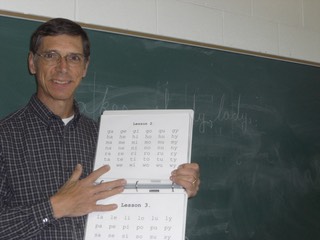
Don Teaching Webster's Syllabary
Introduction
Since 2004 I have become increasingly interested in the old Spelling Book method of teaching reading. This page is dedicated to presenting everything on Internet that I can find with reference to the Spelling Book method. By the way, Spelling Books were used to teach reading and not just spelling.
Positional Statement: The old Spelling Book Method of teaching reading, with its Alphabet, Syllabary, and Tables of Words arranged by levels of difficultly and accent, produced high levels of literacy that remain unrivaled to this day. The old Spelling Book Method is perfect as a stand alone for beginning reading or as a supplement for advanced reading and spelling skills for students who have learned basic phonics with Word Mastery and/or Blend Phonics.
Positional Definition of Reading: "It should be always borne in mind that reading is the enunciation or pronunciation of words by syllables." Lyman Cobb 1842 Cobb's New Spelling Book in Six Parts. See Cobb's "Address to Teachers."
Positional Definition of Spelling Book: "A book for teaching children to spell and read." Noah Webster's 1828 American Dictionary of the English Language. Webster defines spell: "Spell: to tell or name the letters of a word, with proper division of syllables, for the purpose of learning the pronunciation, children learn to read by first spelling the word.”
Positional Essay: Why Noah Webster's Way Was the Right Way by Miss Geraldine Rodgers. The background history and theoretical orientation necessary to understand why Noah Webster's Spelling Book Method has remained unsurpassed and merits renewed use in today's classrooms.
Historical Perspective: Essay by Alice Ranlett published in the May 1904 edition of Education on "The Passing of the Spelling Book." Ronald P. Carver noted, "...spelling was used to teach reading for almost 200 years, but by the beginning of the 20th century, the tide has turned so that learning to spell was largely seen as incidental to reading." The Causes of High and Low Reading Achievement (2000). Quoting Perfetti, Carver adds, "practice at spelling should help reading more than reading helps spelling." Read my "Carver Quotes" for more information. Louisa Cook Moats tells us that the 2000 NRP Report neglected to include spelling (and handwriting) among its five components of effective reading instruction, but later research indicates their importance.
White Paper: “Creating Better Readers and Writers: The Importance of Direct Systematic Spelling and Handwriting Instruction in Improving Academic Performance" by J. Richard Gentry, PhD. I recommend Dr. Gentry’s Zaner-Bloser Spelling Connection hands down as the best spelling program available for public, private and homeschool. Here is an Overview of the program. Dr. Gentry told me on March 26, 2024 that Z-B has published an excellent Spelling-Connections Samplers, just click on the numbered circles for a good insight into each grade level. Remember, the best way to create fluent readers is to teach systematic spelling from grade to grade.
Phonics-First, Syllables-Always Blog sponsored by Donald Potter & Elizabeth Brown.
Here is a Conference I did on on Using The Bible to Teach Reading that features Webster’s Spelling Book.
Access to Written Language is the Point of Literacy Instruction. A YouTube explaining Webster’s approach to literacy.
Vulnerable Students Need Explicit Spelling Instruction: "Celebrate a comeback in explicit spelling instruction to revitalize equity in reading education for children vulnerable for reading failure." J. Richard Gentry 8/31/22
Noah Webster's Spelling Book Method for Teaching Reading and Spelling
I have been working since 2009 on an updated edition of Webster's 1908 Elementary Spelling Book. I typed it as I was teaching it, keeping just ahead of my students. The students made great progress in their reading and spelling.
1. On March 11, 2014, I published Webster's Spelling Book Method for Teaching Reading and Spelling with Create Space.
You can order copies by clicking on the title.
2. Webster's Spelling Book Method for Teaching Reading and Spelling for the Twenty-First Century. This is the same as the revised Create Space edition.
. Webster Syllabary Wall Charts. This large size Syllabary is for the revised 1908/2014 edition. These Table reflect my years of using the Syllabary.
4. Webster's Spelling Book Progress Chart. I made this to help teachers keep track of their students progress. Just write the dates in the Table squares when the students finish a Table.
5. Webster Syllabary Audio Instruction. This is for the 2014 CreateCreate edition.
6. Webster Training Video. This is a June 2017 Video featuring a detailed explanation of the use of the Syllabary.
Psalms Reader: For Teaching Twenty-First Century Children to Read and Worship Their Creator. This is the 1650 Scottish Psalter. I have divided the words into syllables for beginning readers. Here is a 1872 History of the Scottish Metrical Psalms.
Webster 1824 American Spelling Book
Noah Webster's 1824 American Spelling Book newly formatted by Donald L. Potter and published in an easy-to-read version for reading instruction in the Twenty-first Century. This version includes all the pictures and text.
Donald Potter Supplements for Webster’s 1824 Spelling Book
1. Analysis of Sounds. An audio file demonstrating Webster's analysis of English speech sounds.
2. Vowel Key and Syllabary. An audio file demonstrating the Vowel Key and Syllabary
3. Webster's Syllabary, Quicktime slide presentation with audio.
4. Webster's Syllabary Wall Charts. These are for the 1824 edition. Large print 8" x 11" Wall Charts printed in landscape mode.
5. Webster 1824 Spelling Book Flash Cards. These flashcards teach the alphabet in print and cursive. They also include Webster's Syllabary.
6. Student Progress Chart for Webster's 1824 American Spelling Book. This chart divides Webster's Tables into 16 Steps. I use it with all my tutoring students. You will be amazed at students' high reading levels and advanced spelling competence after they finish these 16 Steps.
7. Webster 1824 for Modern Public Schools. This is a special edition of Webster's 1824 American Spelling Book with the pictures and text eliminated. It is a smaller file for rapid download and economy printing, and has nothing that would be objectionable to the modern secular classroom.
8. Webster's 1783 Grammatical Institutes of the English Language, Part I, was the original Spelling Book by Noah Webster. I plan to eventually published an updated version. For now, here is the work I have done as of 1/13/12. You can purchase a very high quality reproduction of the 1783 edition at Grammatical Institutes.
Other Editions of Webster:
1. Years ago I published a scanned copy of Webster's 1908 Elementary Spelling Book. I have removed my scanned pages now that it is available from Google. Here is the Google Book edition of Webster 1908.
2. Here is what I believe is an 1800 edition: Webster's Spelling Book After a careful comparison in Dec. 2012, confirmed that this is very close to the 1824 edition. In a very few cases the tall s (f) lingers. And a few words are different; nevertheless, this clear, crisp scan helped me determine some of the numerals over the letters, and clear up some other issues caused by the poor print of my 1824 hardback reprint.
3. Webster's Blue-Backed Speller This is older than the 1824 edition and a bit different.
4. If you prefer to purchase a hard back copy of a pre-1829 edition, follow this link: Webster's Blue-Backed Speller, 1824.
5. Here is a edition of Webster's American Spelling Book, 1822. This is the same as my 1824 edition.
6. The year 1829 was a turning point for Webster's Spelling Book. He switched from figures (numbers/superscripts) for coding his sounds to dictionary diacritics and added some sight-words. Here is the 1829 edition in a 1833 printing: 1829 American Spelling Book Here is a 1832 printing: Webster 1829. Careful examination shows that this formed the basis for all further editions through the last in 1908.
Online Reference Works Relating to Webster's Life and Work
Here are some sample pages from Noah Webster and the American Dictionary by David Micklethwait. Lyman Cobb wrote critical reviews of the 1829 edition: 1830 Review, 1844 Review. Here is a book on the life and work of Noah Webster: Notes on the Life of Noah Webster (1912, Vol. 2). Noah Webster by Horace E. Scudder (1881). Here is a very nice reader Webster published in 1836: Instructive and Entertaining Lessons for Youth. I highly recommend it to all youth. Noah Webster 1758-1843 by Jennifer E. Monaghan. Here is a Webster Dictionary from 1833. Here is a whole pager of links to material about Noah Webster: Noah Webster Links. The Forgotten Founding Father (2011) video by Joshua Kendall. Here is The Forgotten Founding Father in paperback.
Other Older Spelling Books with Syllabary and Tables
Charles Hoole's 1660 A New Discovery of the Old Art of Teaching transcribed by Thiselton Mark, 1912. Contains a description of how the old spelling books were taught. Not actually a spelling book.
Nathaniel Strong (1706) England's Perfect School-Master. Clear explanation of how to teach reading with syllables. A very important book.
Thomas Dyche 1707 Guide to the English Tongue.
Here is Dilworth's' 54th Edition published in 1793: New Guide to the English Tongue. Note use of double accent. Webster elected not to use double accents.
Asa Rhodes 1802 An American Spelling Book. Here his 1803 The New Instructor Being the Second Part of the American Spelling Book. Both books are excellent.
Abner Keeland 1814 American Defining Dictionary.
Perry's New Pronouncing Spelling Book (1823). This is Isaiah Thomas American edition. Unique in its mode of combining numerals and diacritical marks. Perry's method of teaching one vowel letter with all its sounds is reminiscent of Charles Walcutt's Through the Phonics Barrier. A gold-mine of information on teaching reading. Thomas edition of Perry's Royal Dictionary gives a lot of insight into his method of indicating pronunciation. Here is the British edition of Perry's Royal Dictionary. Here is an article 1949 article by Gladys G. Nelson on Isaiah Thomas.
Mavor 1825 The English Spelling Book
And here is the 1726 Oxford Spelling Book.
Nathan Guilford 1831 Western Spelling Book.
L. W. Leonard 1834 North American Spelling Book. A magnificent work using later diacritical marks. Leonard's work is notable in that it contains extensive reading lessons in a perfectly decodable format, proving that "decodable text" are not recent inventions. I dare say that no current decodable text can match Leonard for depth of coverage. The "Preface" is especially insightful, meriting careful attention.
J. S. Denman 1853 The Student's Spelling Book, 11th ed. Still used figures but introduced Webster's later diacritical marks.
Here is a book giving rare insights into how reading was taught from "THE BLACK-BOARD" by John Goldsbury, 1847.
Here is Lyman Cobb's Address to Teachers. Here is Cobb's New Spelling Book (1842). Here is Cobb's 1849 edition.
Here is The Pronouncing Spelling Book (1830) by J. A. Cummings. This book is important because it shows how Webster's Syllabary was pronounced.
Hezekiah Burhans 1826 The Critical Pronouncing Spelling-Book.
Check out this valuable 1846 book: The New English Spelling book Designed to Teach Orthography and Orthoepy.
Here in an invaluable 1853 spelling book both practically and theoretically: The Student's Spelling Book.
Benjamin Dudley Emerson's The National Spelling-Book and Pronouncing Tutor (1856, 1858). This ranks very high as a superior spelling-book for teaching reading.
Here is Wright's Orthography.
Here is 1860 The Scholar's Companion. Unquestionable one of the best Spelling Books of all times. William Russell's 1863 Spelling-Book, or Second Course of Lessons in Reading and Spelling. A good book, but beware of some of his other books.
William Russell's 1844 Spelling-Book or Second Course of Lessons in Spelling and Reading.
Alexander McGuffey's 1865 New Eclectic Spelling Book. I have been looking for this spelling book ever since I read in the 1878 edition that former editions used "superiors," that is numbers to indicate vowel sounds. Webster called the numbers "figures." This is a major find, 6/8/09! A superb book.
Joseph Guy's 1850 Victorian Spelling Book.
Honoria Williams' 1830 Syllabic Spelling, or A Summary Method of Teaching Children to Read. A very important work on both theoretical and practical grounds. Well worth careful study.
The Improved Guide to English Spelling (1829) by William Bentley Fowle. This was an early attempt to dispense with diacritical marks and use word classification to teach reading and spelling. A distinctive American contribution.
The Practical Spelling-Book, with Reading Lessons (1859) by Thomas Hopkins Gallaudet and Horace Hooker. This is one of the very finest spelling books with a syllabary, yet organized upon very modern lines. It embraces a phonogram approach. I highly recommend this book.
The North American Spelling Book with a Progressive Series of Reading Lessons (1835) by L. W. Leonard. Dr. Gene Roth, a fellow spelling book researcher, wrote me about this book on 8/27/12. I currently consider it the best Spelling Book for teaching reading and spelling that I have reviewed. It uses the newer diacritical marks instead of numerical superiors. The reading lessons are 100% decidable and many are of morel, religious, and literary merit.
Spelling Book, Adapted to the Different Classes of Pupils: Complied with a View to Render the Arts of Spelling and REading Easy and Plain to Children (1811) John Comly.
The Three Stooges Swing the Alphabet: This funny little skit would be better named, "Swinging the Syllabary." I add it here partly for fun but also to show ways that the syllabary was probably taught at one time. According to Wikapedia: In 2005, film historical Richard Finegan identified the composer of the song as Septimus Winner (1827-1902), who had originally published it in 1875 as "The Spelling Bee."
Newer Spelling Books without Syllabary, but Phonetically Based
Blumenfeld's Alpha-Phonics Primer (1983, 1997, 2005). I am including this modern primer because it is essentially a spelling book method of teaching reading. I have used it since 1994 with excellent results.
Adult Learner’s Gide to Selling (2008) by Anne Betteridge.
A Primary Spelling Book of the English Language with Illustrations (1877) by Loomis Joseph Campbell. Unquestionably one of the most delightful and well organized phonics/spelling programs ever written.
The New Spelling Book (1846) While this book is not exactly phonetically based, I am including it because it teaches the Anglo-Saxon, Latin, Spanish, and Greek elements of English in a very systematic fashion.
American Speller by Henry Noble Day
The First Book of Word and Sentence Work (1901) by Marshman William Hazen. The Second Book of Word and Sentence Work. A teaches both cursive and print. Phonetically based and progressively organized. A masterpiece. Here is an earlier work (1895), Complete Spelling Book.
Town's New Speller and Definer (1866) by Salem Towns. A profound work. Sander's Union Speller (1872) is somewhat similar.
McGuffey's Eclectic Spelling Book, 1879. This was very popular in the Midwest for many years. It was used by my ancestors. I have a well used copy that they used. An excellent book, still in print at Amazon: McGuffey's Spelling Book. I think the 1865 book above which still used the superiors instead of Webster's later diacritical marks is superior to this book. They are both good, but the 1865 is my favorite.
Here is the 1896 edition of Pollard's Synthetic Speller. Here is the 1887 edition of Pollard's Advanced Speller
Spelling Book Indiana State Series, 1891. A good spelling book based on modern phonics principles.
The National Pronouncing Speller by Richard G. Parker and J. Madison Watson. A masterpiece! I finally found their National First Reader: Primer of Word-Building. I am told that the Reader started with some sight-words and phony phonics, but I see no objectionable elements to this Speller.
And Ear and Eye Spelling Book: A Book on Word Study for the Primary Grades by Albert R. Sabin (1904). This is an excellent spelling book for first through fourth grade. It would, also, serve well as a beginning phonics method. It is also available from Sabin.
Here is The Progressive Speller (1907) by F. P Sever.
Elementary School Speller (1916) by J. N. Hunt.
Wilson's Larger Speller (1846) by Marcus Wilson. Superb example of what a superior Speller should be.
Hyde's Derivation of Words: with Exercises on Prefixes, Suffixes, and Stems (1896). An excellent work for advanced readers.
The Constructive Etymological Spelling-Book (1852) by James A. Christie. This ranks very high on my list of favorite spelling-books based on etymology. This is the definitive answer to dumbing-down. He also wrote, The Rhyming Spelling Book Containing More Than 13,000 Words Arranged on a New and Natural Principle for Teaching Spelling by Transcription (1873).
The Freedman's Spelling Book by the American Tract Society (c1866). Used to teach former slaves how to read. It has some very good pronunciation, phonics, and reading exercises.
A Study of English Words (1897) by Jessica McMillan Anderson. A reference book on the history, spelling, and usage of English words. Not a spelling book.
Word-Building: Fifty Lessons, Combining Latin, Greek, and Anglo-Saxon Roots (1892) by Brainerd Kellog and Alonzo Reed A masterwork!
A Complete Etymology of the English Language by William Smith (1873). A superb work that can dramatically increase your vocabulary.
The Derived Spelling Book by John Rowbotham. A very user-friendly book.
Rathburn's Graded Speller (1908) by George Daniel Rathburn. Very complete and usable.
The Mastery of Words - Book One: A Course in Spelling Arranged for Grade One through Five Inclusive by Sarah Louise Arnold (1917 & 1920).
Word Studies by Edwin Samuels Sheppe (1905). This book includes beginning and advanced studies with instructions for teachers. It is very comprehensive. I hope to publish it in a paperback edition someday.
Spelling Made Easy by Marvin Dana (1919). A good explanation of spelling rules.
The Spelling-Book Consisting of Word in Columns and Sentences for Oral and Written Exercises Together with Prefixes, Affixes, and Important Roots from the Greek and Latin Languages by William D. Swan (1854). I highly recommend this book as a clear path out of darkness into light. A review from 1894 is inserted below.
DC HEATH CO. BOSTON
THE PROGRESSIVE SPELLER (DC Heath co. Boston) by FP Sever 142 pp.
This book would never have been recognized as a speller in days lang syne when plain isolated columns of words as unattractive as they were meaningless stared the pupil in the face and took away all the desire to learn anything. This progressive speller is prepared to meet the ideas of modern educators as to the manner in which the English language should be taught, for it is as much a language book as a spelling book. Indeed the student who masters this book will have learned to spell without knowing it. Part I. is designed for the youngest children and abounds in oral class work. In Part II. more attention is given to constructive work by older children. Phonics as a guide to pronunciation are introduced in the first lesson and continue to the close of the book. Script words are also a part of the first work and is at once utilized for seat work and sentence making by the lowest grades.
The book will be an efficient help to the thousands of teachers who are trying to find out the best ways of teaching children to speak and write the English language correctly. Primary Education, March 1894.
The Primary School Spelling-Book by William D. Swan (1858). This book is easier than the one above.
Orthoepy and Orthography of the English Language; a Course of Reading with Private Pupils (1866) by Rev. E. R. Levante, MA. A fabulous book, loaded with an amazing amount of well organized practice material.
First Steps in Spelling (1874) By Lewis B. Monroe. Undoubtedly one of the finest spelling books ever published. It is systematic phonics at its best and definitely child-friendly.
New Word-Analysis, or, School Etymology of English Derivative Words (1879) by William Swinton. A very attractively written book of great value.
The Modern Spelling Book: Designed as a Guide in the Study of the Orthography, Pronunciation, and Meaning of Common English Words by J. H. Hunt and H. I. Gourley (1883). A masterpiece deserving modern emulation. Written before the unfortunate introduction the schwa into our modern dictionaries. Later Hunt published Modern Word Book for Elementary Grades: An Elementary Course in Phonics and and Spelling (1914). Another masterpiece. Notice how phonics and spelling were coupled at that time to make superior readers and writers.
Wheeler's Elementary Speller (1901) by W. H. Wheeler. MY PICK! This is my favorite speller because of the great phonics and wonderful literature. The pictures are works of art. This is a book for beginners, to proceed the next book on this list.
Wheeler's Graded Studies in Great Authors: A Complete Speller (1899) by W. H. Wheeler. This is a unique speller in which all the words are illustrated in selections from great English authors. A delightful book that combines good literature with good spelling practice. This is NOT a book for beginners, but it is a great book for advanced students wanting to improve their spelling and for gaining a taste for good literature and noble thoughts.
A Manual of Orthography and Elementary Sounds by Henry Romaine Pattengill (1900). A very valuable book for learning the practical use of the diacritical marks.
English Words as Spoken and Written: Designed to Teach the Powers of Letters and the Construction and Use of Syllables and Words (1900) by James A. Bowen. A deluxe introduction to the English Phonogram method of teaching spelling.
Watson's Complete Speller: Oral and Written by J. Madison Watson (1878). This book was published when Orthographic Giants roamed the American halls of learning. A must book! Watson also published an easier book designed to be an introduction to his Complete Speller. It even includes handwriting lessons. Watson's Graphic Speller: Oral and Written (1884). "The Speller the Substructure of Schooling."
An Advanced Rational Speller for The Highest Grammar Classes and Secondary Schools (1913) by Ida M. Daly.
A New Spelling Book on the Comparative Method with Side-Lights from History (1893) Alfred M. Holden.
The Common-Word Spellers (1921) by Ervin Lewis. Fassett recommends this in his 1922 Beacon Teacher's Manual as a good phonics based spelling book. I looked at it through and agree. It is an excellent spelling book.
New-World Speller: Grades 1, 2, 3. This 1911 spelling book is another example of an excellent example of an informed phonics based approach to teaching spelling. I found it advertised in the back of Tidyman's The Teaching of Spelling.
A Primary Spelling Book of the English Langage (1877) by Joseph Emerson Worcester. An admirable method. It is available from Amazon in paperback.
Phonetic Spelling for College Students (1960) by Ralph M. Williams. Influence by Ann Gillingham. A superb book for college students wanting to improve their spelling. Thoroughly up to date.
How to Improve Your Spelling (2014) by Donald L. Potter. This document consists of extracts from Harry Shefter's (1959, 1961) 6 MINUTES A DAY TO PERFECT SPELLING. I have found Mr. Shefter's methods to be highly effective in helping my students improve their spelling and reading abilities.
Thirty Spelling Contest (1920) by Herbert Parsons Patterson. An immensely useful work based on Leonard Ayres' Spelling Scale. Schools and homeschool parents will want to use this book.
A Common Sense Spelling Book (1913) Thomas W. Butcher. This book lives up to its title.
South-West Series Spelling Books: Grades One through Four (1931). An excellent little speller.
Horn-Ashbaugh Spelling Book 1920. Perhaps in its day, the most popular Spelling Book in America.
SCHOLARS' SECTION
ADVANCED REFERENCE WORKS ON SPELLING
Spelling Research: A Guide to Curriculum Planning (2011) Zener-Bloser publication. A compilation of up-to-date articles.
Should We Teach Spelling Part 1; Should We Teach Spelling Part 2, by Timothy Shanahan.
American English Spelling: An Informal Description (1988) by D. W. Cummings. A very detailed and thorough work.
The Science of Spelling: The Explicit Specifics that make Great Readers and Writers (and Spellers! (2017) by Dr. J. Richard Gentry. A stirring and informative book on the importance of spelling.
Resources Materials for Teaching Spelling 2nd ed. (1968) by Paul S. Anderson and Patrick J. Groff.
Spelling, Handwriting, and Dyslexia (2006) by Diane Montgomery. Some excellent material.
Spelling Structure and Strategies by Paul R. Hanna, Richard E. Hodges and Jean S. Hanna. A very in-depth study of English spelling based on the a computerized study of English spelling. A very important advanced work.
English Sounds and English Spelling (1878) F. G. Fleay. A very distinguished work. He also published The Logical English Grammar (1852-3, 1884). Another very fine book, with a different way of analyzing (diagramming) sentences.
"On the Analysis of the Memory Consciousness in Orthography" by Edwina E. Abbott. A famous research paper on spelling, from Psychological Review 1901.
The Teaching of Spelling by Tidyman. This was referred to in the Common-Word Spellers by Ervin Lewis. Tidyman's work is an excellent example of first-class scholarship.
The Child and His Spelling: An Investigation of the Psychology of Spelling...... by W. A. Cook and M. V. O'Shea. (1914).
Henry R. Pattengill's (1900) Manual of Orthography and Elementary Sounds (10th Ed.) An excellent manual, includes practical exercises. I can't help but mention his delightful book: Hints from Squints: a Book of Fun and Fodder, Gumption and Grit, Pedagogy and Philanthropy, Morals and Manners.
Every-day Pronunciation (1918) by Robert Palfrey Utter. This is not a spelling book, but it is a delightful study of American and English pronunciation that is well worth pursuing.
James Napoleon McElligott (1845) Manual, Analytical and Synthetical, of Orthography and Definition.
Concrete Investigation of the Material of English Spelling (1915) by W. Franklin Jones.
Webster's American and Elementary Spelling Books began with a Syllabary. Very little recent research is available on the teaching of a syllabary. Here is one study that you may find interesting, "Teaching Reading by Use of a Syllabary." (1972). I have taught Webster's syllabary and hope to publish the results of my work in the near future.
Gentry Grade-Level Spelling Test. This is the best spelling test I have found. here is m printed version of the Gentry G-E Spelling Test. Gentry is one of the authors of the 2012 Zaner-Bloser Spelling Connections program, which I consider very good. Here is J. Richard Gentry's excellent article, "The Importance of Direct, Systematic Spelling and Handwriting Instruction in Improving Academic Performance.” Here is Gentry’s “Monster Test” based on his developmental theory of spelling development. Here is a YouTube Explanation of the Monster Test.
"Messing Up Literacy in Texas: Why have reading scores flatlined in Texas" (2016) by J. Richard Gentry. I heartily agree with Mr. Gentry criticism of the new Texas Standards. I agree with his quote from Virginia Berlinger, “In an era of limited financial resources, it is important to keep in mind that systematic handwriting AND spelling instruction can reduce the number of children needing special education services.”
“The Neuroscience of Word Study: Igniting the Reading Brain K-1” These are Power Point slides of a workshop by Dr. Gentry. These slides are well worth considering. Dr. Gentry is a true leader in the field of reading and spelling. I count it an honor to have him mentoring me in my daily work teaching reading.
What Does Spelling Have to Do with Reading Comprehension? Presented by Louisa Moats at the April 2010 Idaho RTI Conference.
Quotes from Ronald P. Carver's 2000 The Causes of High and Low Reading Achievement. This is a document of quotes that I have chosen from Carver's book with explanation, comments, and applications. I hope it will interest others in purchasing Carver's book to see how we can use spelling instruction to increase student reading efficiency.
American Spelling Instruction by Bob Schlagal & Woodrow Trathen.
How to Teach a Syllabary: by Dr. Eugene Earl Roth, Jr. (Dec. 2009). This is the chapter “Of reading English speedily” from the book Ludus Literarius: or, The Grammar School, by John Brinsley first printed in 1612. The archaic spelling of many words has been modernized by Dr. Roth. The instructional style is a dialogue between two teachers. From about 1600 to 1820 syllabaries were in every Spelling Book, and syllabaries were the foundation of beginning reading instruction. Syllabaries were used by every teacher of reading, and children were required to master these. There was no instruction in how to use the syllabary in the later Spelling Books because everybody knew how to use one. Then that knowledge was lost by 1850. Now almost no one knows what a syllabary is, or how to use one, or the benefits of using them to teach reading. Dr. Roth's work has been very helpful to me in understanding the "lost pedagogy of teaching reading with the syllabary." This is an important paper for both the history of beginning reading instruction, as well as for people who are using Webster's Spelling Books to teach children how to read.
The Art of Reading and Writing English (1720) by Isaac Watts. Note especially his "Directions for Reading." The first three may be summarized: 1. Take pains to acquire a perfect knowledge of the sounds of all the letters in general, 2. Do not guess at a word at first sight, if you are not well acquainted with it, lest you get a habit of reading falsely. 3. Pronounce every word clearly and distinctly.
Biblical References in Shakespeare 's Plays by Naseeb Shaheen.
Teaching Reading by Use of a Syllabary (1972), by Lila R. Gleitman & Paul Rozin. A very important paper.
"Why Spelling is Important and How To Teach It Effectively" (2008) by Virginia W. Berninger. An up-to-date encyclopedia article on spelling.
Real Spelling. Gina Cooks told me, "There is much work to be done in the orthographic world. Are you familiar with Real Spelling? If not, you must be. This man is the Copernicus of English orthography. He has a better understanding of it than anyone, living or dead. His work is why I went back for a PhD midlife, with a job and a family." Gina just published a short TedED that is a must see: Making Sense of Spelling.
Wonderful Website: www.vocabularyspellingcity.com offeres an enormous amount of excellent information on improving spelling instruction.
Etymology.com. A one-stop site to answer your questions relating to etymology of English words. I use it all the time.
"The Relationship between Alphabetic Basics and Word Recognition and Reading" by Marilyn Jager Adams. The indispensable foundation for spelling is a knowledge of the alphabet, which obvious fact is curiously overlooked in our day and age.
Why Spelling? The Benefits of Incorporating Spelling Into Beginning Reading Instruction. Rebecca Treiman.
Spelling Development and Disability in English by Derrick C. Bourassa & Rebecca Treiman.
What Do Spelling Errors Tell Us about Language Knowledge? by Jan Wasowicz, Ph.D.
How to Learn to Spell (1902) by O. E. Latham. A master work on learning how to spell.
Elizabeth Brown recently alerted me to Susan C. Anthony's Spelling Program. Mrs. Brown is using it with her son. She has found it to be highly effective.
"On the Relationships between Learning to Spell and Learning to Read" by Donald Shankweiler and Eric Lundquist (1993) the first sentence is telling, "The study of spelling is oddly neglected by researches in the cognitive sciences who devote themselves to reading."
"Why Spelling is More Difficult than Reading" (1997) by Anna M. T. Bosman and Guy C. Van Orden. They conclude that spelling and reading are interdependent, and phonology mediates both of them, but that reading is not the best way to teach spelling. They especially disprove of testing students spelling with multiple choice test that contain wrong spellings.
Spelling Zone. This is a comprehensive interactive Online course in English Spelling.
Longitudinal Relationships Between Reading and Spelling In Early Elementary Grades: Testing Causality Using a Cross-Lagged Panel Design (2013) by Ekaterina Petrofina Forrester. To me it is just common sense that there has to be a casual relationship between spelling and reading. I would never think of teaching them separately.
Simultaneous Oral Spelling: This is a helpful explanation of the Orton-Gillingham SOS spelling technique. I use it everyday in my teaching.
“The use of a diagnostic spelling tests in the analysis of spelling problems" (1954) Geraldine L. Whitted. A very valuable study.
“Why Teach Spelling” by Deborah K. Reed, The University of TX at El Paso. An excellent, up-to-date argument for teaching spelling systematically.
“How Words Cast Their Spell: Spelling Is an Integral Part of Learning the Language, Not a Matter of Memorization, American Educator Winter 2008-2009 by R. Malatesha Joshi, Rebecca Treiman, and Louisa Moats.
Phoneme-Grapheme Correspondences as Cues to Spelling Improvement (1966) A classic computer driven study of English spelling, still important in the field.
Creating Better Readers and Writers: The Importance of Direct, Systematic Spelling and Handwriting in Improving Academic Performance (2010) by J. Richard Gentry, PhD., and Steve Graham. Ed.D. A very important paper by leaders in the field. Here is my Youtube presentation of Creating Better Readers and Writers. Gentry’s essay is a direct refutation of Pearson’s Words Their Way. Here is another insightful Review of Words Their Way.
The Child and His Spelling (1914) W. A. Cook & M. V. O’Shea. A justly famous and valuable study.
Iowa Spelling Scale (1922) by E. J. Ashbaugh. A very important study, mentioned in the 1957 edition of Romalda Spalding’s Writing Road to Reading. This book contains the Buckingham Extension to the Ayres List.
Dos and Don’ts of Teaching Spelling by Monique Nowers. A very helpful blog.
Spellography: A student roadmap to better spelling (2003) by Louisa Moats & Bruce Rosow. A most interesting and practical book. Well organized, making good use of phonemic awareness segmentation and manipulation tasks.
Learning to Read and Spell: A Child’s Knowledge of Words (1981) by Edmund H. Henderson. Fascinating reading.
Research on Handwriting and Spelling, National Conference on Research in English (1964-1966) by Thomas D. Horn.
Learning to Spell (1981) by Richard Hodges. Good theoretical and practical information.
Spelling Across Languages: Research, Theory, and Practice Across Languages (1997) Edited by Charles A. Ferfetti, Laurence Rieben, & Michael Fayol. A stellar host of contributors. Linnea C, Ehri wrote chapter 13, “Learning to Read and Learning to Spell are One and the Same, Almost. She concluded, "Poor spellers do not develop into skilled readers. Spelling instruction must remain an important goal of teachers and schools.”
Does Spelling Still Matter - and If So, How Should It Be Taught? Perspectives from Contemporary and Historical Research (March’s 30, 2021) by Steven Pang, Timothy Rickard, & Robert Research.
Drill Book in Dictionary Work (1897) Thomas Metcalf and Charles De Garmo. Excellent book. Wish we had something similar for our dictionaries today.
A Guide to Teaching Spelling (1921) by Hugh Clark Pryor & Marvin Summers Pittman.
Spel… is a Four-Letter Word (1987) by J. Richard Gentry,
Children’s Creative Spelling (1986) bu Charles Reed. He also wrote Children’s Categorization of Speech Sounds in English. (1975)
Understanding English Spelling (2004) by Marsha Bell. A true masterpiece in the field of spelling research.
Teacher’s Manual of Spelling (1918) Grace M. Fernald - and "A Study of the Psychology of Spelling" (1916). Note especially her Speller for Elementary Schools, Book 1, which is basically a method for teaching the Ayres Spelling Scale! California Teacher’s Manual of Spelling, Including Books I and II (1918) by Grace M. Fernald. Remedial Techniques in Basic School Subjects (1943). Intelligence Tests and School Reorganization (1922) multiple authors including Fernald.
The Teaching of Spelling (1951) by James A. Fitzgerald. Very valuable. A companion volume (1951) A Basic Life Spelling Vocabulary was also published.
A New Spelling Book on the Comparative Method with Side-Lights from History (1893).
Sight and Sound: A Handbook of Spelling (1967) by Paul Richard Craven.
Words Their Way Primary Spelling Inventory and Feature Guide. I can’t vouch for this inventory, but it is interesting. It is based on the Word Their Way theory of the stage development of spelling. Other theories will produce different tests, and test results
Sharing the Secrets: Teaching Your Child to Read (1994) by Ruth Scott & Sharon Siamon. Spelling: Sharing the Secrets (1992). I am impressed with Ruth Scott’s 1991 The Student Editor’s Guide to Words. The latter book would make a good gift to older struggling spellers, but appears to be out of print.
The Best Way to Learn Spelling! by Ed Garnham. An excellent video based on Precision Teaching.
Gentry Grade-Level Spelling Test by J. Richard Gentry.
Dr. Louisa Moats explaining the Scholastic Selling Program.
No Time for Spelling
"No time for spelling,"
Is what the supervisor said:
"They got to pass the reading test!"
And I started feeling sad.
Because as Dr. Gentry taught us,
“If you really want to read
The spell-to-read approach
Will put you in the lead."
by Don Potter, May 27, 2022
(in Response to Dr. Gentry's 5/27/22 PT article,
"New Study Highlights Integrating Spelling Instruction?)
The Truth about Reading and the Spelling Approach
Excerpt from The Spelling Progress Bulletin: Winter 1968
by Leo G. Davis
WHOLE WORD APPROACH: Unquestionably the “w-w” (whole-word) experiment has turned out to be the most deplorable blunder in academic history. It not only produced countless youngsters who can’t read, but also saddled us with a crew of teachers, few of whom have any practical knowledge of the fundamentals of alphabetical orthography. Expecting a 5-yr-old to develop a lasting mental picture of a whole word is basically identical to the “turky-track” approach to literacy that has been a millstone around the Oriental’s neck for eons. But worse yet, under current practices the child is expected to “figure out” words to which he has never been exposed, and without any knowledge of what phonics we do have. Idiotic! With that kind of thinking (?) going into our school programs it’s a wonder that any child ever learns to read! As a natural result of the “look-GUESS” fiasco, current researchers are looking for “guessing” aids (clues) by which children may guess strange words. They haven’t done enough research to discover that there were no guessing aids prior to the w-w debacle, because children were taught to SPELL the words before trying to read them.
SPELLING APPROACH: Prior to the w-w fiasco there were no “reading” failures per se, because all up-coming, new words were listed as SPELLING exercises ahead of the narratives introducing them, and vocabularies of other texts were controlled to minimize the chances of children encountering strange words, until they had learned to use the dictionary, after which there was no instruction in reading (decoding). In the old-fashioned spelling class children were taught meticulous pronunciation, spelling, encoding, meaning, word recognition, self-expression (in defining words), all in one course. The initial “attack” on words was made in the SPELLING class, rather than in literature. Although we frequently forgot exactly how to spell a given word, we seldom failed to recognize it where it was already spelled. Thus there were NO “reading” failures, just SPELLING failures, due to the idiotic inconsistencies of traditional orthography. Current researchers seem to look upon spelling as the result of reading, rather than as the traditional approach there-to. They seem to expect children to “catch” spelling thru exposure, like they do the measles.
This Spelling Book Reference Page was launched 8/11/2008. Latest additions 5/5/2023.
